
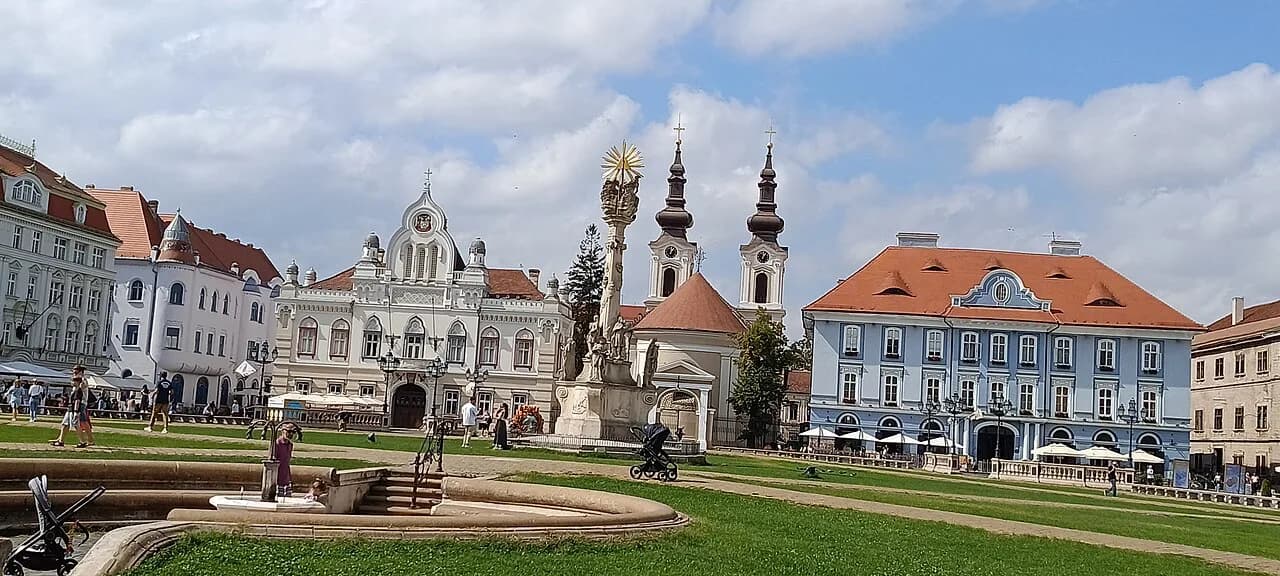
Piața Unirii, Timișoara: A Visitor's Guide to the Baroque Square

Piața Unirii is free to walk through at any time, so treat the square itself as a public space rather than a ticketed sight. Its draw is the arrangement of buildings around one open cobbled expanse: the Catholic Dome to the east, the Serbian Orthodox Cathedral to the west, the Baroque Palace to the south and 18th-century merchant houses to the north. This guide covers where the square sits, what to look at on each side, how long to allow and how it fits with the rest of Timisoara.
Where Piața Unirii sits and how to reach it
The square lies in the Cetate district, the old fortress core of Timișoara, and is reached on foot from the surrounding streets rather than by any dedicated stop. The explanatory heritage page for the square gives the name in its Habsburg form, Domplatz, and notes that the square was sketched on a plan of 1733 and finished later at larger dimensions than that plan set out. Use the square's own name, Piața Unirii, on maps and signage; the address is Piața Unirii, Timișoara 300085.
Arriving on foot is straightforward because the square connects directly with the streets of the old centre, and Piața Libertății is about two minutes away on foot. If you are coming from further out, work out your route to the Cetate district first and finish the last stretch walking, since the surrounding lanes are narrow and one-way in places. Allow a little slack for finding the correct side of the square, because the buildings are best approached on foot rather than by car.

The four sides of the square
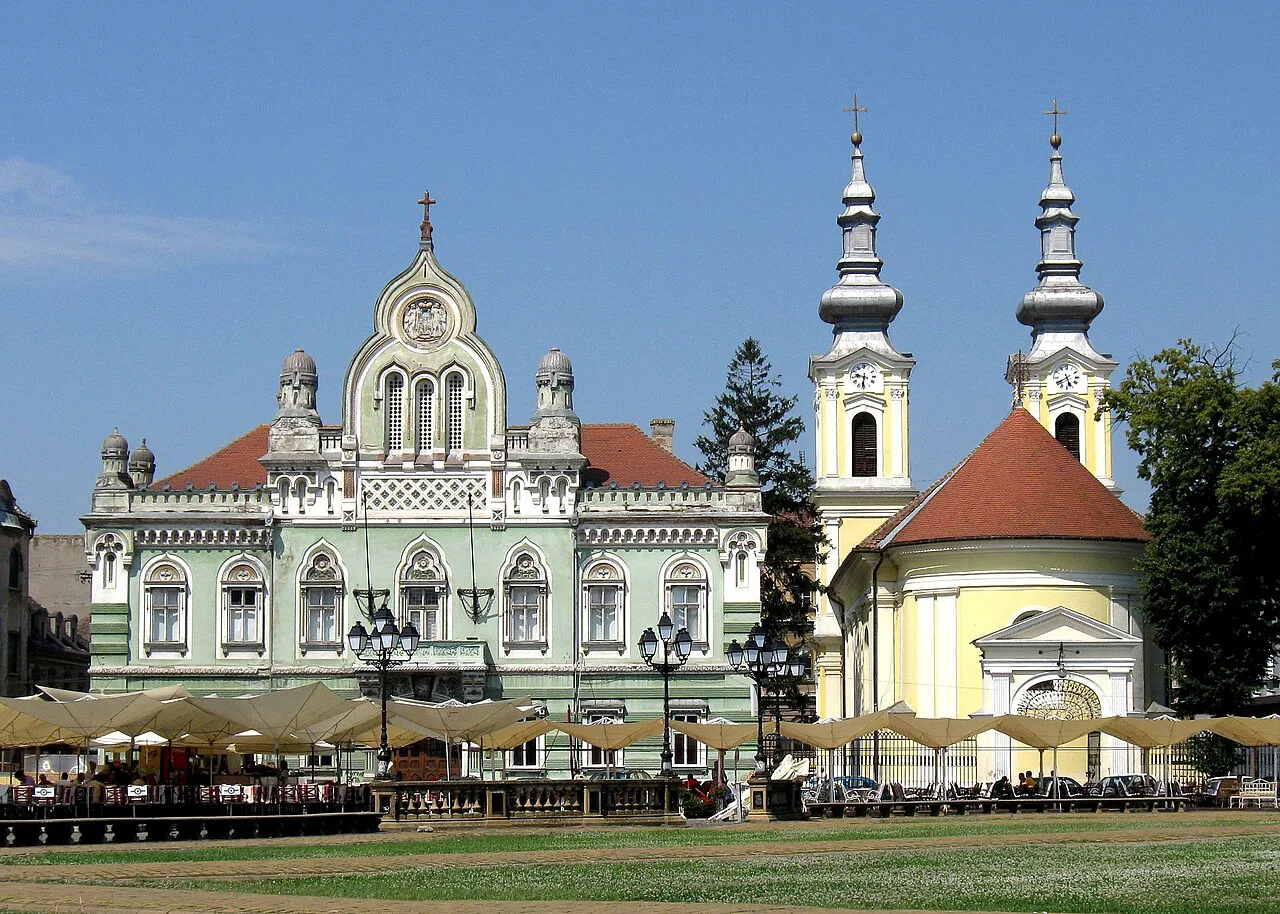
Read the square as four sides and it makes sense immediately. The Roman Catholic Dome stands on the east side, the Serbian Orthodox bishop's cathedral faces it from the west, the Baroque Palace closes the south side and typical 18th-century houses line the north. The heritage description treats this ring of representative buildings as a compact picture of Timișoara's 18th-century architecture, even though individual buildings have changed over time.
Walk a full circuit before choosing where to stop, because the view changes with each quarter turn. The two cathedrals face each other across the open centre, which is why the square reads as a conversation between denominations rather than a single monument. That layout also means the best photographs of the Dome are taken from the western half of the square, near the Serbian cathedral.
Inside the Catholic Dome
The Catholic Dome is worth entering for its ceiling frescoes and the vertical space they sit above. Step inside rather than only photographing the twin towers from outside, because the interior is where the building's height becomes obvious. Keep the visit short if you are short of time: the dome interior is a single, contained space rather than a complex of rooms.
The square is open at all hours, so the Dome can be seen from outside early or late, but the interior is tied to the church's own pattern of services. Plan the interior stop for the middle of the day and treat an open door as the signal to go in.
The Serbian Orthodox Cathedral and its iconostasis
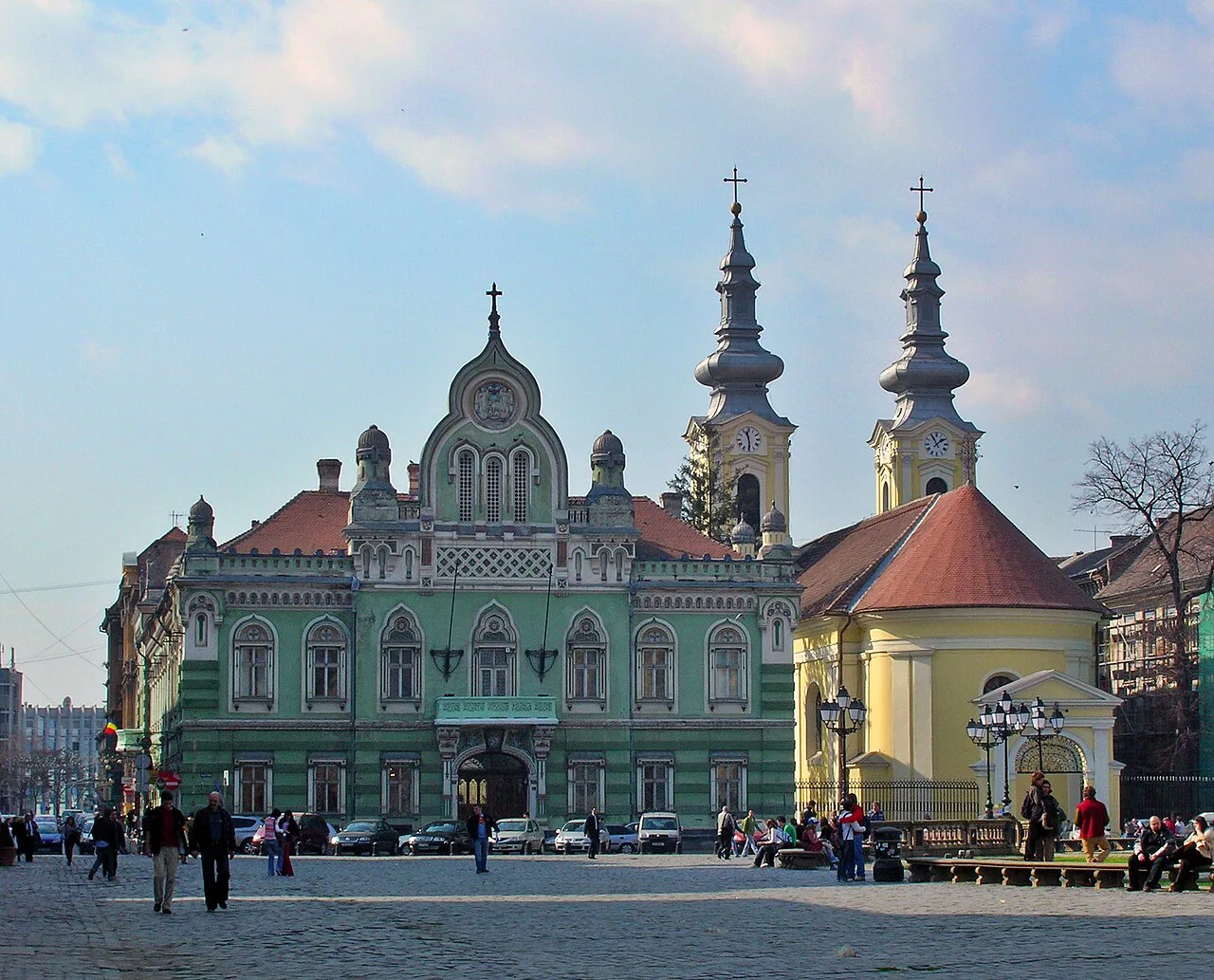
Across the square, the Serbian Orthodox Cathedral answers the Dome with a green-topped, Byzantine outline, and its interior holds an iconostasis described as one of the finest in the Banat region. Look at the screen of icons rather than only the painted walls, since that is the element singled out as the interior's strength. The two cathedrals within a few dozen metres of each other are the clearest expression of the square's mixed heritage.
The city has a second, much larger Orthodox landmark elsewhere, so keep the two apart in your plan. The Serbian cathedral here belongs to the square and is visited as part of the circuit; the Timișoara Orthodox Cathedral (Catedrala Mitropolitană) is a separate building with its own guide and its own visiting logistics.

The Baroque Palace and the Art Museum
The Baroque Palace on the south side houses the Art Museum, and this is the one part of Piața Unirii with a published ticket and timetable. The museum holds Romanian and European art across three centuries in rooms with original parquet floors, and it is regularly passed over by visitors who photograph the façade and move on. Give it at least an hour if you go in.
The published hours are Tuesday to Sunday, 10:00 to 18:00, with admission listed at 15 RON, and the same page notes that museum hours vary seasonally. Treat those as the listed details and confirm them at the desk before paying, because hours and admission are the details most likely to shift with the season.
The palace itself is the former seat of the Banat provincial administration in the 18th century, which explains its long, institutional façade. Reading it that way makes the building easier to place: it was civic power fronting the square before it became a gallery.
The Trinity Monument at the centre
The Trinity Monument, or plague column, stands at the centre of the square and commemorates the plague epidemic of 1738 to 1740, giving thanks for the city coming through it. The column was sculpted in Vienna in the Baroque style and brought down the Danube, the Tisa and the Bega canal before being erected in the square between 1755 and 1758. Look at the base and the sculptural group rather than only the column shaft, since the figures carry the dedication.
The square's visitor listing gives the plague column a date of 1740, while the heritage account dates the epidemic to 1738 to 1740 and places the column in the square between 1755 and 1758. Expect to see two dates quoted around the city. Neither changes how you visit: the column sits in the open centre and is seen in passing as you cross between the two cathedrals.
Merchant houses and details worth slowing down for
The northern side is a run of 18th-century merchant houses, and the details are what reward a slower walk: wrought-iron balconies, carved doorways and pastel façades that each differ from the next. The heritage account describes these houses as representative of the century's architecture even after later alterations, so look at what survives at street level rather than expecting untouched originals. Café terraces fill the south side in summer, which is a good place to sit and look back across the full square.
Details are easy to miss if you cross the square at speed, so build in one slow lap with your head up. Look at the façades above shop level, where the balconies and carved surrounds sit clear of signage.
How long to allow and the best time of day
Allow one to two hours for Piața Unirii itself, and add at least an hour if you are going into the Art Museum. Early morning gives you the square without crowds and the light on the Dome is at its best, while late afternoon brings golden light across the cobbles and the façades. Midday in summer is busiest and the most contrasty for photographs.
If your time in the city is tight, the square works as a short stop between larger sights rather than a half-day in itself. Pair the open square with the museum interior and you have a comfortable morning without rushing either.
Nearby: Piața Libertății and the wider centre
Piața Libertății is about two minutes away on foot, with the Old Town Hall and a smaller square that follows naturally from Piața Unirii. Liberty Square (Piața Libertății), Timișoara is the sensible next stop if you are already standing in the Baroque square, and it keeps you moving through the old centre without a long walk between sights.
Victory Square (Piața Victoriei), Timișoara is the other square worth adding, and it shifts the mood from Baroque to the city's later civic layout. Use Victory Square Timișoara as a separate stop with its own points of interest; it does not sit beside Piața Unirii.
Grouping the squares on foot works well because each one leads into the next through the old streets. Choose two squares and one interior for a half day, and leave the rest for a second walk.
Practical points before you go
Confirm the Art Museum's current hours and admission at the desk, since the published timetable already varies with the season. The square itself needs no ticket, and there is no booking to arrange for walking through it.
Wear shoes that cope with cobbles and uneven paving, because the surface around the perimeter is stone rather than smooth asphalt. Read the square's layout before arriving so you know which cathedral to look for first.
Is Piața Unirii worth an hour of your trip?
Yes, provided you go for the square itself rather than a single building. The free, open cobbled space ringed by the Dome, the Serbian cathedral, the Baroque Palace and merchant houses gives you a compact read on Timișoara in an hour or less, and the Art Museum extends that to a half day.
Start early for the empty square and the light on the Dome, go into the museum if you have the time, then walk the two minutes to Piața Libertății. That sequence uses the centre efficiently and leaves the rest of the city for another day.