
Sighișoara Clock Tower (Turnul cu Ceas): What to See and How Long It Takes

The Clock Tower, Turnul cu Ceas, is the gate tower on the south-eastern side of the upper citadel in Sighișoara, and climbing it gives you both the town's History Museum and its best-known balcony view. Budget about an hour if you read the museum rooms, or half an hour if you only want the panorama. This page covers where the tower sits, how to walk up to it, what is on each level, when the museum opens and what to see nearby.
Plan the tower as the anchor of a half-day in the citadel rather than a quick photo stop. The museum is spread over several floors, the clock mechanism sits at the top, and the balcony is a separate stop on the way down. Readers who only want the view can skip the exhibition rooms, but the climb is the same either way.
What the Clock Tower is and where it sits in the citadel
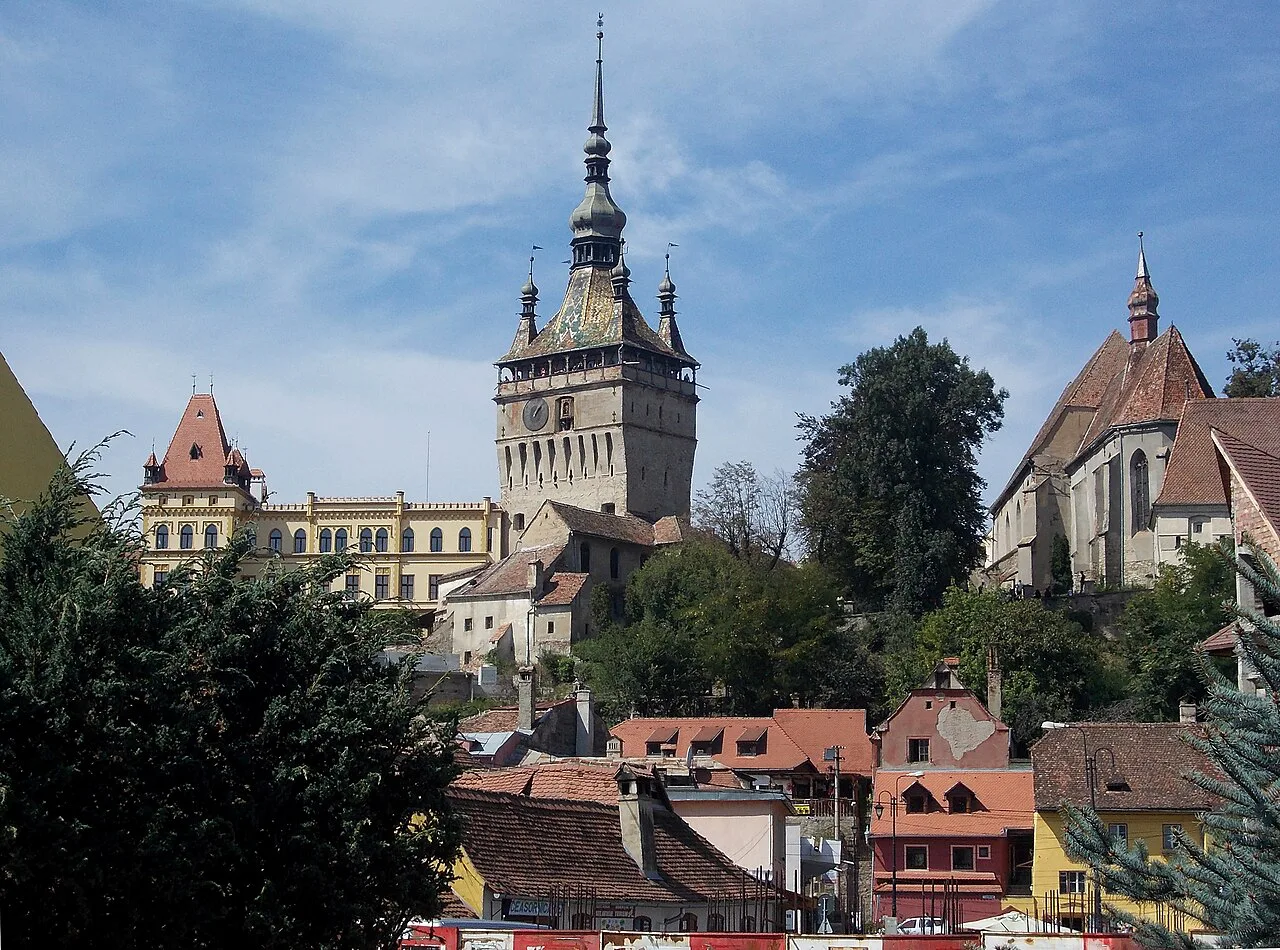
The tower stands on the south-eastern edge of the citadel's lower plateau, where the main gateway opens from the Lower Town into the walled centre. It was built to defend that gate, and it served as the town hall until 1556 before becoming the home of the History Museum in the 19th century. The surrounding walled centre is what appears on the UNESCO World Heritage List, not the tower on its own.
Approach it as the front door to the old town: once you pass under the tower you are inside the citadel, with Piața Cetății (Citadel Square) opening up beyond. That makes the tower a natural first stop on arrival rather than something to save for the end. Allow a few minutes on the cobbles outside before you go in, because the exterior is where the roof and the clock face read best.
Inside, the tower has two rooms on each level, with the ground floor dating from the 14th century. The building was raised and reshaped after the fire of 1676, which is why the upper stages and roof look later than the base. Keep that sequence in mind as you climb: the stone at the bottom and the brick above tell you what survived and what was rebuilt.

How to reach it from the Lower Town and Piața Cetății
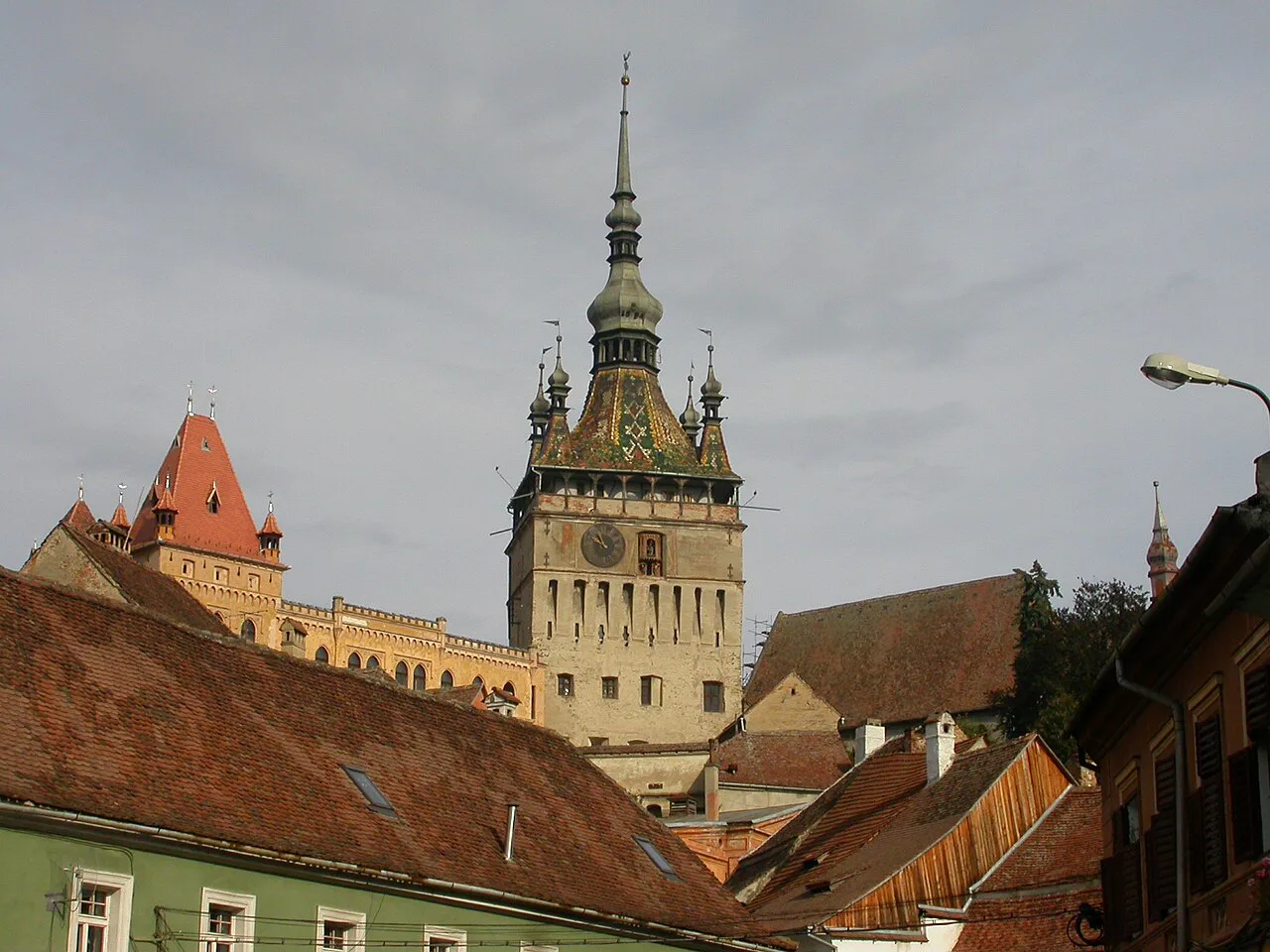
From the Lower Town, walk uphill through the streets of the old centre until you reach the gate passage under the tower. The tower is the entry point to the citadel's lower plateau, so you do not need to aim for a separate address: follow the lane uphill and the tower closes the view ahead. Wear shoes with grip, because the approach is cobbled and slopes.
Once through the gate, Piața Cetății is the square to orient yourself by, with the tower behind you and the lanes of the citadel running off it. If you are coming from the upper part of town instead, you will arrive on the plateau side and see the tower's roof rather than its gate face. Either direction works, but arriving from below gives you the better first view.

The tower itself: height, levels, roof and balcony
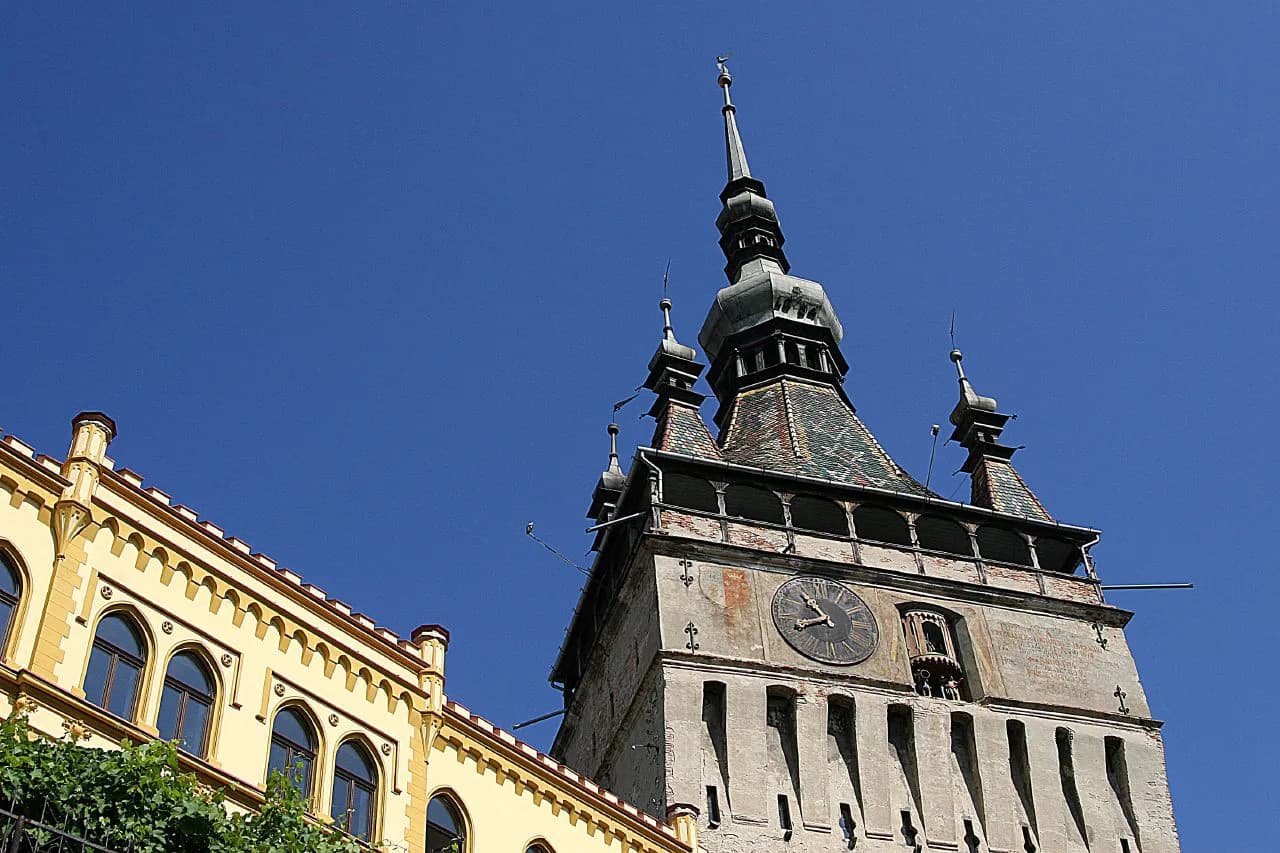
The tower rises over five levels, with the top stage set back slightly and an open gallery around it; visitor sources put its height at 64 to 65 metres. The balcony at the top level is the town's main observation point, and it is the reason many visitors climb at all. Treat the height as the practical fact it is: you are going up a medieval gate tower, floor by floor.
Look at the roof on your way in. In the 16th century the tower carried four corner turrets, a mark of a town with the right to impose the death penalty, and the baroque rebuilding after 1676 gave it the shape you see now. The gate passage itself is part of the same complex, so the visit starts before you buy anything.
The clock, the figurines and the 1906 mechanism
The clock was installed at the fourth level in 1648, and its linden-wood figures show the days of the week as classical gods and goddesses, alongside Peace, Justice, day and night, and two fighters who strike the quarter hours. The figures were restored in 1677 after the fire. They are the detail worth waiting for on the hour.
The mechanism you see at the fifth floor was made in 1906 by J.J. Fuchs & Sohn of Bern and is now electrically driven, turning a platform that carries seven figurines for the days of the week. That means the working clock is an early-20th-century replacement for an older one, not a medieval machine. Knowing this saves you from hunting for 17th-century gears that are no longer there.
The History Museum inside: miniature city, archaeology, pharmacy, guild rooms
The History Museum fills the tower and is the town's main museum, arranged as thematic rooms rather than one chronological route. The centrepiece is a miniature reconstruction of Sighișoara as it looked in 1735, built in 1950 from Austrian maps studied in Vienna between the wars. Start there if you want a mental map of the citadel before you walk it.
On the first floor the archaeology room holds pottery with incised decoration from the Middle Bronze Age, plus weapons and altars from the same period. The second floor is given over to the pharmacy collection, with wooden, porcelain and glass containers, a medical kit and 17th- and 18th-century diplomas, reflecting the two hospital centres that grew up beside churches in the medieval town. Higher up, a furniture room ranges from the 16th century onwards, and the guild room gathers tools, insignia and handicrafts from the blacksmiths, locksmiths, shoemakers, tailors, carpenters, furriers and tinsmiths of the fortress.
A rural furniture room shows pieces of the painted Saxon interior from the Târnava Mare area, and the ceramic room holds Saxon cups, mugs and plates made in potters' workshops in and around Sighișoara. These rooms are small and stacked vertically, so the museum reads as a climb with displays, not a single gallery you can skim. If your time is short, choose the miniature city, the clock floor and the balcony and accept that you will miss some rooms.
The balcony view over Sighișoara
The balcony at the top of the tower gives a panorama over the whole town, from the citadel roofs down to the Lower Town. Go up for this if nothing else: it is the clearest way to see how the walled centre sits above the streets below. Allow ten minutes at the top rather than treating it as a quick glance, because the layout only makes sense once you have seen it from above.
The balcony is on the last level, after the clock mechanism, so the order of the climb puts the view at the end and the descent afterwards. Read the town from up here, then use what you see to pick your next stop, whether that is the church on the ridge or the lanes back towards the square. The tower is the practical place to plan the rest of your walk.
Opening hours and the Monday closure
A 2021 visitor page lists the museum as open Tuesday to Sunday, 9.00 to 15.30, closed on Monday. Treat those times as the pattern to plan around and confirm at the ticket office or on the site before you build a day on them, because a 15.30 close leaves no room for a late-afternoon climb. A Monday in Sighișoara should be built around the citadel streets instead.
Ask the price at the tower's ticket office when you arrive, in lei, and check whether the ticket covers the museum rooms and the balcony together. Carry cash as a sensible fallback, and buy on the spot rather than relying on a third-party listing.
How long to allow, and when to go to avoid the climb queue
Allow 45 to 60 minutes for the tower and museum together: roughly 20 minutes for the displays, 10 for the clock floor and 10 on the balcony, with the rest taken by the stairs. If you only want the view, 20 to 30 minutes is enough. The climb is the fixed cost of the visit, so decide before you enter whether you are doing the whole tower or just the top.
Aim for the first hour after opening on a weekday, when the museum is quietest and the stairs are freest. With a 15.30 close, the last climb of the day starts early enough that you are not rushed through the rooms. Avoid the middle of the day in high season if you want the balcony to yourself.
Nearby: Church on the Hill, Casa Vlad Dracul, Casa cu Cerb
The Church on the Hill (Biserica din Deal) sits on the ridge above the citadel and is reached by the covered Scara Școlarilor (The Scholars' Stairs), a separate climb from the tower and worth keeping distinct in your plan. Casa Vlad Dracul, on Str. Cositorarilor, is the house associated with Vlad III, the historical figure, and it is not connected to Bram Stoker's fictional Dracula. Casa cu Cerb, the Stag House on Str. Școlii, is a short walk from the square. Pair one of these with the tower rather than trying to do all three climbs in a single afternoon.
Back down on Piața Cetății, the Venetian House and the Monastery Church (Biserica Mănăstirii) are both within a few minutes of the tower's gate, so they fit around a tower visit without extra travel. Use the Sighisoara Attractions guides to slot the rest of the citadel around your climb, and keep the tower as the fixed point in the day.
Is the Clock Tower worth the climb?
Yes, if you want the museum and the balcony in one stop. The tower combines the town's History Museum, its clock figures and its clearest view, all inside the gate you have to pass through anyway. Readers who dislike stairs should treat it as a view-point visit only and go straight up.
Go on a Tuesday to Sunday morning, check the day's closing time and ticket price at the office, and leave the Church on the Hill for a separate climb. That way the tower is a solid hour rather than a rushed detour.
Explore more Sighisoara guides
Frequently Asked Questions
Is the Sighișoara Clock Tower the same as the Church on the Hill?
No. The Clock Tower is the gate tower on the lower plateau of the citadel and holds the History Museum. The Church on the Hill stands on the ridge above and is reached by the covered Scholars' Stairs, so they are two separate climbs.
Can I visit the Clock Tower without entering the museum?
The balcony sits at the top of the tower, above the museum rooms and the clock floor, so the climb passes through the displays. If you only want the view, go up without stopping in the rooms and allow 20 to 30 minutes.