
Fabric, Timișoara: what to see in the city's historic industrial district

Fabric earns a half-day, not a full one. Piața Traian and the monumental frontage of Bulevardul 3 August 1919 sit within one continuous walk, with the Status Quo Synagogue, the Millennium church and Queen Mary Park filling the gaps between them. This guide sets out what to see, in what order, who the district suits, and how it sits within the wider set of Timisoara Neighbourhoods: 4 Area Guides.
What Fabric is and where it sits in Timișoara
Fabric lies east of the city centre, on the far side of the Bega canal, and reads as a historic district with a working past rather than a museum set. The city council calls it one of Timișoara's most valuable historic neighbourhoods, and its regeneration plan covers more than 90 hectares of historic and adjoining land, including residential streets, the industrial zone along Strada Pestalozzi and the banks of the Bega.
The canal is the key to the layout. One arm of the Bega once ran past the Status Quo Synagogue and was later covered to form a street, so the water you see today is not the whole original picture. The city now plans to open the south bank between Podul Dacilor and Podul Andrei Șaguna to complete the canal promenade.

Who Fabric suits, and who it does not
Fabric suits travellers who have already walked the centre and want architecture at close range without crowds: Secession palaces, a Moorish-style synagogue and a large square that functions as a real neighbourhood centre. It rewards slow walking and looking up at facades rather than ticking off attractions.
It suits you less if you want a compact cluster of ticketed sights with fixed opening times, or if you have only an afternoon in the city and have not yet seen the centre. Fabric's landmarks are streets, squares, churches and a park, seen from the outside, so the visit is about the walk itself.

Traian Square (Piața Traian) and the palaces around it
Piața Traian is the central square of Fabric, and its present appearance dates from the turn of the nineteenth and twentieth centuries, when large palaces were built on all four sides. Earlier buildings around the square were modest, mostly single-storey and rural in look, which is why the enclosure feels so uniform today.
On the square stands Ștefania Palace, the former town hall, built in 1908-1909 to plans by the architect László Székely in the Secession style of the 1900s and named after 1918 for the wife of its interwar owner, Rudolf Totis. Treat the square as your first stop and orient yourself from it: the avenue and the synagogue are both a short walk away.
3 August 1919 Avenue and its monumental frontage
Bulevardul 3 August 1919 presents a single unified northern frontage of monumental buildings between Piața Academician Corneliu Micloși and Splaiul Nistrului. The row includes the Neptune palace, the palace of the widow Székely, and the Karl Kunz, Franz Anheuer, Ignatz Haymann and Miksa Steiner palaces, so walk it as one sequence rather than picking out individual houses.
This is the stretch to walk slowly, on the palace side, in the late afternoon when the facades catch the light. It links naturally with Traian Square at one end, so you can do the two set pieces back to back without doubling back.
The Status Quo Synagogue and the Millennium Roman-Catholic Church
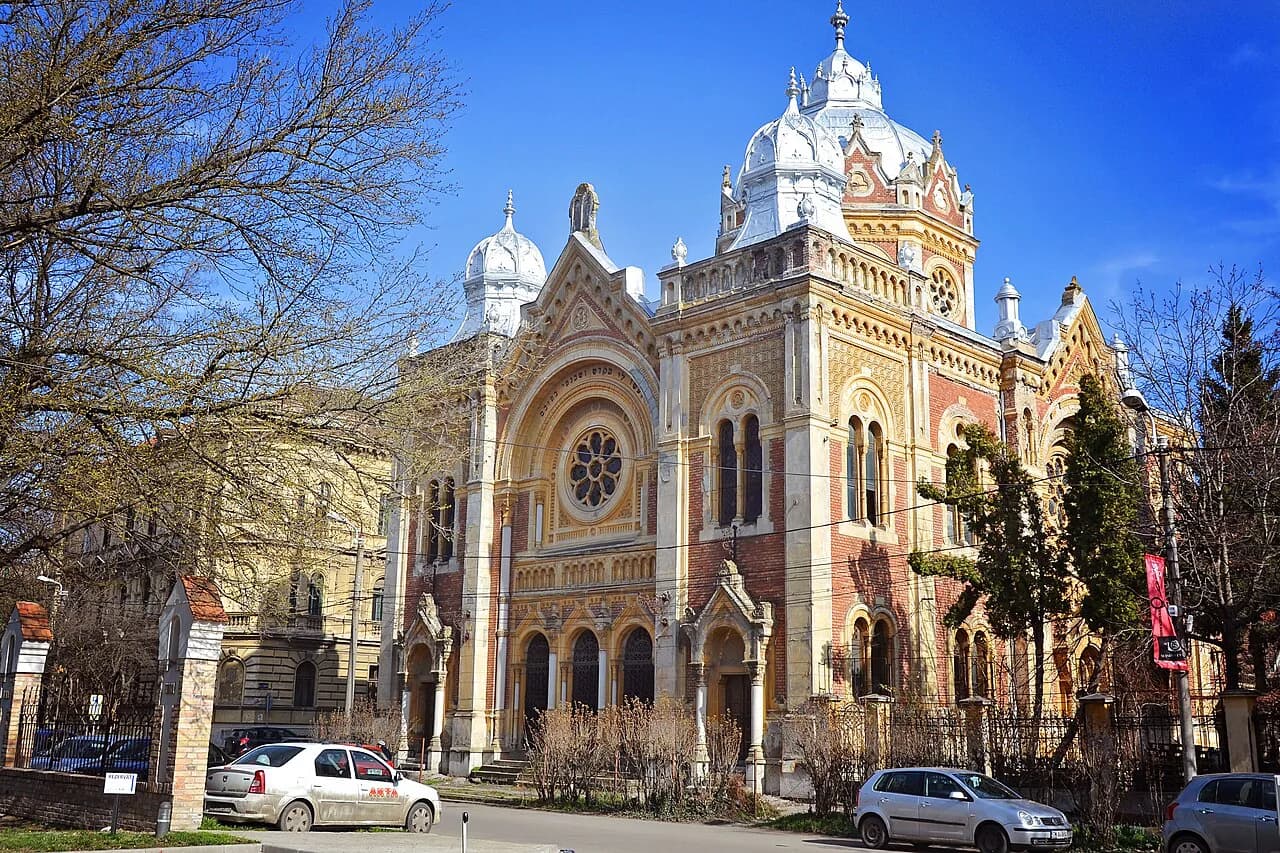
The Status Quo Synagogue was built by the Status Quo mosaic community in 1899 in the Moorish style, originally on the bank of a Bega arm that was later covered over. The building is the district's most distinctive silhouette, and the story of the vanished water beside it explains why the surrounding streets feel inland today.
The Millennium Roman-Catholic Church, known locally as the Millennium, was built in Roman Square with its facade facing Bulevardul 3 August 1919, which places it neatly on the same walk as the palace frontage. Both the synagogue and the Millennium are working religious buildings seen from the street on this route; treat their exteriors and frontages as the sights.
Queen Mary Park and the Bega canal
Queen Mary Park, formerly Coronini Park, is the oldest park in Timișoara: it was laid out in English style around 1850 on the orders of Count Johann von Coronini-Cronberg, governor of Serbian Vojvodina and Banat Timișoara. It gives the district a green breathing space between the built-up set pieces.
The Bega shapes the walk south and west of the squares, and the Decebal Bridge, begun in 1908 and finished a year later, carried the longest reinforced-concrete beam span in Timișoara at the time. Use the canal as your return leg towards the centre rather than retracing the avenue.
The electric plant and Fabric's industrial character
Fabric's industrial streak is visible in the fabric of the place: the electric lighting company was built after many difficulties and experiments and put into operation in October 1884. That date explains the mix of workshops, plants and grand housing that gives the district its texture.
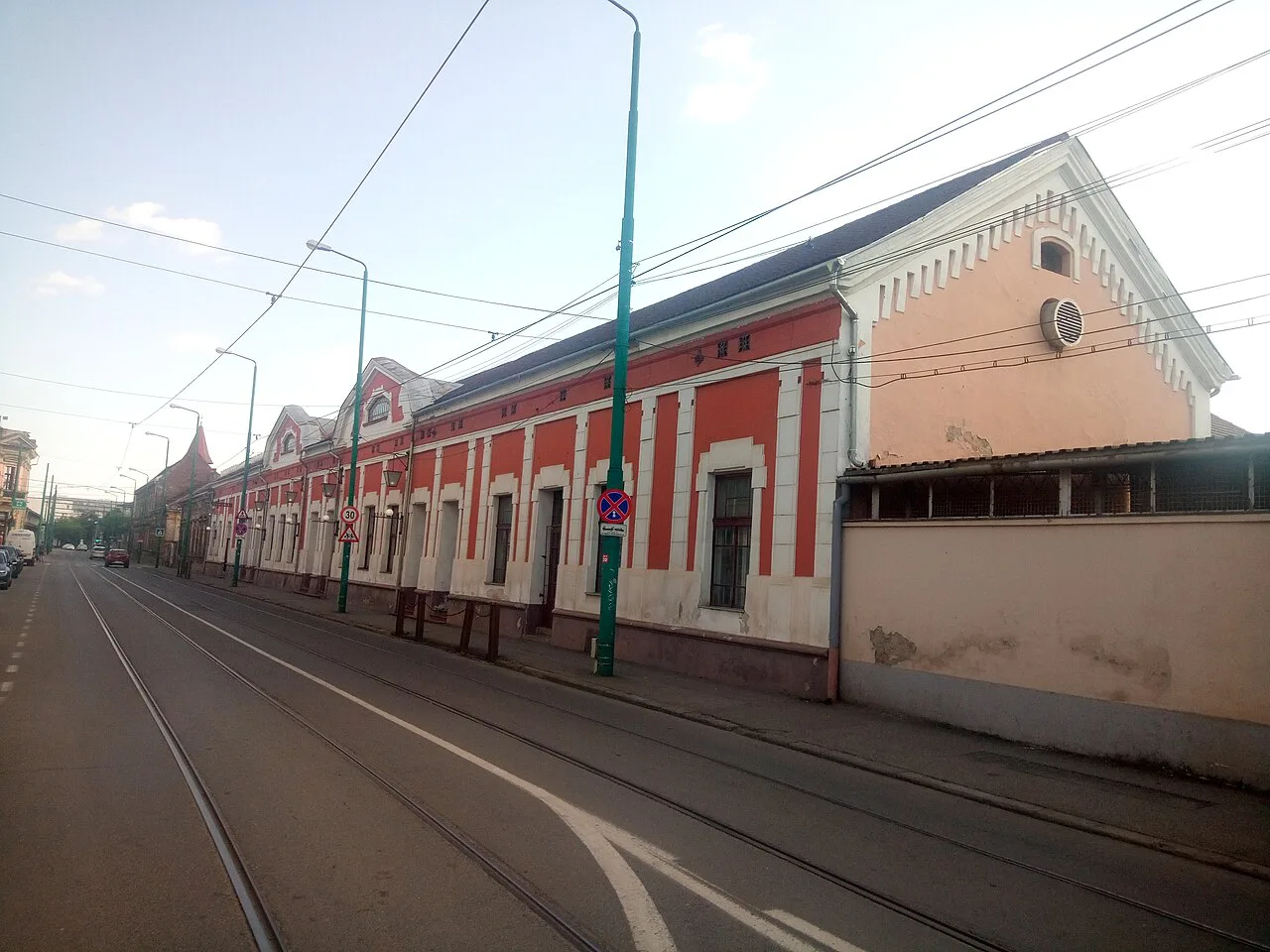
Read the streetscape as a working district rather than a preserved one. The industrial zone along Strada Pestalozzi and the canal banks are explicitly part of the city's planning brief for the area, which is why some corners look raw next to the restored palaces.
Getting to Fabric and moving around it on foot
Fabric is a walking district: from the centre, cross the Bega and head east, and the squares and avenue follow one after another without needing transport between them. Build the route as Traian Square, the palace frontage on Bulevardul 3 August 1919, the synagogue and Millennium church, then Queen Mary Park and the canal back.
Parking is the weak point, which the city acknowledges: the preliminary urban plan identifies two sites for large public car parks, at the junction of Străzile Pestalozzi and Ștefan cel Mare and on Strada Mehadia near the student complex, and proposes converting existing garage rows into modern surface parking. Until any of that is built, arriving on foot or by public transport and leaving the car behind is the simpler choice.
What is changing in the district: the Fabric urban plan in outline
In October 2025 the city approved the preliminary variant of the urban plan for the protected built area of Fabric, prepared by SUBCONTROL for the municipality under a contract worth 1,504,965 lei excluding VAT, with 35 months of services. It is a plan, not built reality: public consultation with residents, businesses, universities and specialists follows, so expect proposals rather than finished works on your visit.
The plan's aims are conservation of the historic architecture, more green space and modernised public spaces, with eco-landscape corridors along the former beds of rivers that once crossed the district and Strada Pestalozzi adapted as a green artery. The most visitor-relevant proposals are the canal promenade extension between Podul Dacilor and Podul Andrei Șaguna and improved connections between the synagogue area and Strada Pestalozzi.
Where to sleep and eat in Fabric
Fabric is a residential district with a growing visitor profile, and its accommodation is spread through the historic streets rather than concentrated in one quarter. Compare what is on offer against the centre before booking, and weigh a quieter Fabric base against the convenience of stepping out of your door into the main squares of the Timisoara City Break Guide.
Eating is a neighbourhood affair here: the squares and main streets carry the cafés and shops, and Piața Traian is the natural anchor for a break mid-walk. Book nothing on the strength of a listing alone; check the current offering when you are in the district.
What is within walking distance of Fabric
Fabric connects directly to the centre across the Bega, so Cetate, Timișoara's main central quarter, is a walk away rather than a trip. That makes it easy to pair a Fabric morning with a Cetate afternoon, or to base yourself in the centre and treat Fabric as a half-day loop.
Iosefin and Elisabetin continue the same historic fabric of the city and can extend the walk if you have the time. Plan the loop with the canal as your spine: out through Fabric, back along the water, using the Bega to link the quarters rather than to separate them.
Is Fabric worth the walk from the centre?
Yes, for half a day, if you walk it as a route rather than a checklist: Traian Square, the palace frontage, the synagogue and Millennium church, the park, then the canal back. It suits travellers who like architecture in a living neighbourhood; skip it if your time in Timișoara is a single afternoon and the centre is still unseen.
Go soon if you want to see the district mid-change: the urban plan is approved only in its preliminary form, so the car parks, canal promenade and green corridors remain proposals for now. Check the current state of any works before planning a route around them.