
Darvas-La Roche House: Oradea's Art Nouveau Museum

The Darvas-La Roche House is the one Oradea interior to build a morning around if Art Nouveau is your reason for coming. Built between 1909 and 1912 by the architects László and József Vágó, the house has been restored and now holds the Muzeul Art Nouveau, the city's museum of the style.
This guide covers what to read on the façade from the pavement, what to look for room by room inside, how long the visit takes, and which sights sit within walking distance in central Oradea.
What the Darvas-La Roche House is and where it sits in Oradea
The house was built by the Vágó brothers between 1909 and 1912 and after a full restoration opened as the Muzeul Art Nouveau, the newest museum in the city. Its style is Art Nouveau in the Secession version, which means flowing plant forms worked into a strict geometric frame rather than the curvier French variant.
Treat it as a stop on a walk through central Oradea rather than a separate excursion. Oradea's Art Nouveau sights, the fortress and the riverfront sit close enough to link on foot, and the city's attractions guides set out how each one fits.

The building: Vágó László and Vágó József, built 1909–1912
The architects were Oradea-born brothers, László and József Vágó, who worked in the Hungarian Secession idiom at the start of the twentieth century. The house belongs to the building boom of the years before the First World War, when the city was expanding fast.
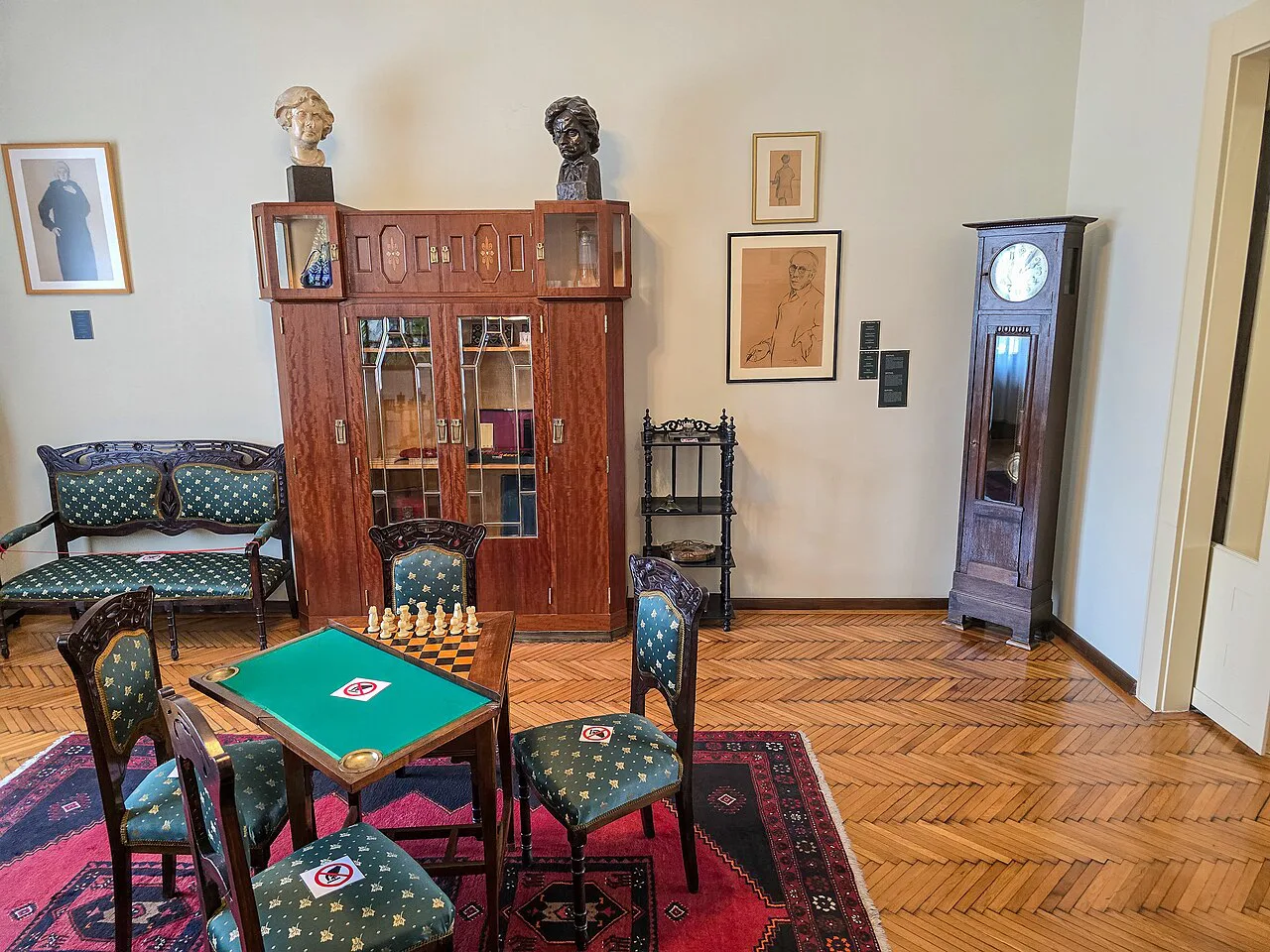
Read the house as a designed villa that has since become a museum, not as a period-furniture set. The restoration kept the architecture in charge, and the exhibition of Art Nouveau material sits inside rooms whose stained glass, ironwork and ceramics were made for the building.
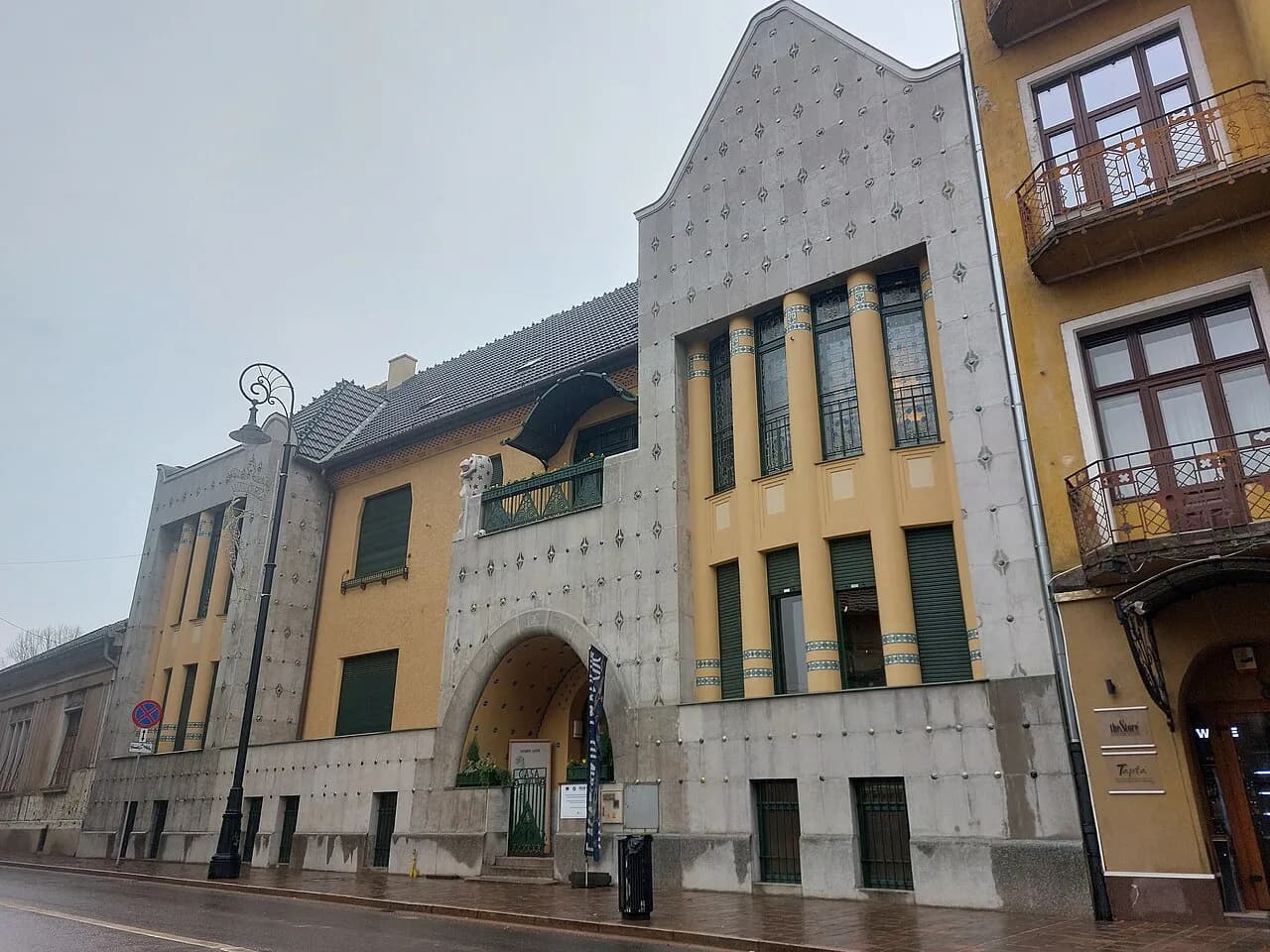
What to look for on the façade: Zsolnay ceramic buttons, balcony, ironwork
Start on the pavement and look up at the decorative buttons of Zsolnay ceramic set into the façade. There are six distinct motifs, glazed in a greenish-blue with the metallic shimmer of eosin, and they give the wall its rhythm.
The balcony above carries openwork decoration built from pine cones, hearts and spiralling plant forms. On the ironwork, look for the triangle holding a tulip, spiral tendrils and vertical bands with sprouting bulbs along the parapet facing the inner courtyard; the iron was shaped to a design that reworks plant motifs in the geometric manner of the Viennese Secession.
This part costs nothing and needs five minutes. If your time in Oradea is short, the façade alone tells you whether the interior ticket is worth it for you.
Inside: the hall glass wall, the upstairs stained-glass window, the bedroom panorama
The reason to go in is the glass. The first original piece to meet you is the glazed wall of the ground-floor hall; upstairs, a stained-glass window showing floral stems rising from a pot with coloured birds pecking at them survives in its original position and form.
The bedroom opens a wide glazed panorama of its own. Across the main rooms, the stained glass carries plant and animal subjects, and the female faces set into the medallions give the composition its character.
Allow time to look at the glass against the light rather than walking past it. The windows sit in the walls where they were designed to be, so the effect changes with the time of day and the weather outside.
The Muzeul Art Nouveau collection housed in the house
The museum uses the restored rooms to present Art Nouveau as a style rather than to recreate one family's household. That double identity is the point: you are reading an architect-designed villa and a museum of the movement at the same time, which is why the decorative detail repays attention.
Photographs of the interior are useful preparation, especially of the glass and the ceramics, so you know which details you want to spend time on.
How much time to allow and in what order to move through the rooms
Give the house about an hour, and a little more if you like decorative arts. That is enough to read the façade, work through the ground-floor hall and the upper rooms, and linger at the stained glass without holding up the rest of your day.
Move in this order: façade first from the street, then the hall glass wall, then upstairs to the window with the birds and the bedroom panorama, then the museum displays. Doing the exterior first means the interior details connect to what you have just seen on the wall.
Tickets, opening days and booking: where to confirm before you go
Ticket prices, opening days and any booking arrangements are handled by the museum, and the Visit Oradea page for the house is the place to confirm the current programme and admission before you travel. Check it in the week you plan to visit, since a museum that has recently opened can adjust its schedule.
If you are building a day around several interiors, confirm each one's days before you fix the order of your walk. A single closed door can reshape an afternoon in a compact centre like this.
What else is within walking distance in central Oradea
The Oradea fortress, Cetatea Oradea, is the obvious next stop: a walled complex with the Princely Palace inside, and enough space to fill the rest of a morning.
The Black Eagle Palace, Oradea's Art Nouveau landmark with its glass-roofed passage, makes a natural pairing with the Darvas-La Roche House because you can compare a public building of the same era with a private villa.
Union Square anchors the historic centre and puts you within easy reach of the Moon Church and the Sion Neolog Synagogue, so the house slots neatly into a single loop on foot.

Is the Darvas-La Roche House worth an hour of your Oradea trip?
Yes, if you care about architecture or decorative arts: the Zsolnay buttons, the ironwork and the surviving stained glass are the reason to go in, and an hour covers them comfortably. If your Oradea time is tight, read the façade from the street and spend the hour at the fortress instead.
Build the visit into a walk that takes in the fortress, the Black Eagle Palace and Union Square, and confirm the museum's current admission before you set out.
Explore more Oradea guides
Frequently Asked Questions
Is the Darvas-La Roche House worth visiting in Oradea?
If Art Nouveau is why you came to Oradea, yes. The house is the city's museum of the style, and the surviving glass, ceramics and ironwork justify an hour indoors. Travellers with limited time can read the façade from the pavement and move on to the fortress.
Can you see the Darvas-La Roche House interior without a ticket?
The interior is the Muzeul Art Nouveau, the city's museum of the Art Nouveau style, housed in the restored rooms of the house. The façade, with its Zsolnay ceramic buttons and balcony, is visible from the street and is worth a few minutes on its own; confirm the museum's current admission arrangements before you travel.