
Union Square, Oradea: a Practical Guide to Piața Unirii

Union Square, Piața Unirii in Romanian, is the paved public square at the historic centre of Oradea, on the left bank of the Crișul Repede. It is a public square you simply walk into, needs roughly 45 minutes to an hour of looking, and rewards anyone who slows down over the building fronts rather than ticking it off. This guide covers where the square sits, how to reach it, what to see around it, and how to fit it into a day in the city. For a wider set of stops, see Oradea Attractions: 8 Visitor Guides.
The square carried several names before the current one, including Small Square, Ferdinand Square and Saint Ladislaus Square, so older maps and locals may use different labels for the same place. Oradea Heritage dates its modern outline to a large-scale rehabilitation completed in 2015, which is the layout you see today.
Where Union Square sits and how it is laid out
Union Square occupies roughly 7,200 square metres in the district once called Orașul Nou, the New Town, which took shape between 1714 and 1740 around a main square. It is entirely pedestrian in feel: benches, paved surfaces, cafés with frontage on the square and buildings standing shoulder to shoulder along its edges.
The three churches on the square are the oldest structures in it: the Saint Ladislaus Roman-Catholic Church, built between 1720 and 1733, the Moon Church, built between 1784 and 1832, and the Greek-Catholic Cathedral of Saint Nicholas, built between 1800 and 1810. Everything else around them arrived later, which is why the square reads as churches hemmed in by palaces rather than a single planned ensemble.
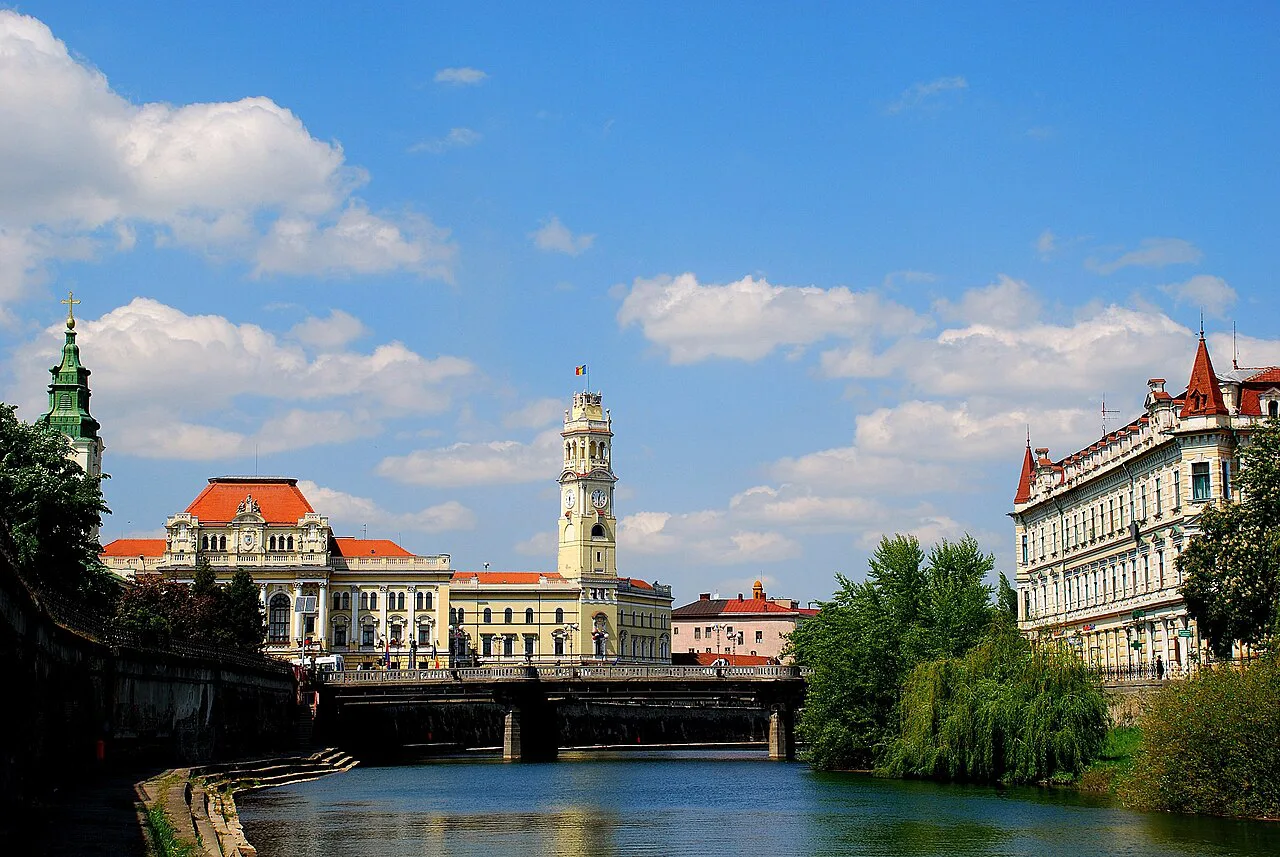
The square is easy to find without a map: it lies in the city centre on the left bank of the Crișul Repede, with the City Hall and its tower standing off the square. If you are arriving by tram or on foot, aim for the City Hall and you will walk straight into it.

The palaces that frame the square
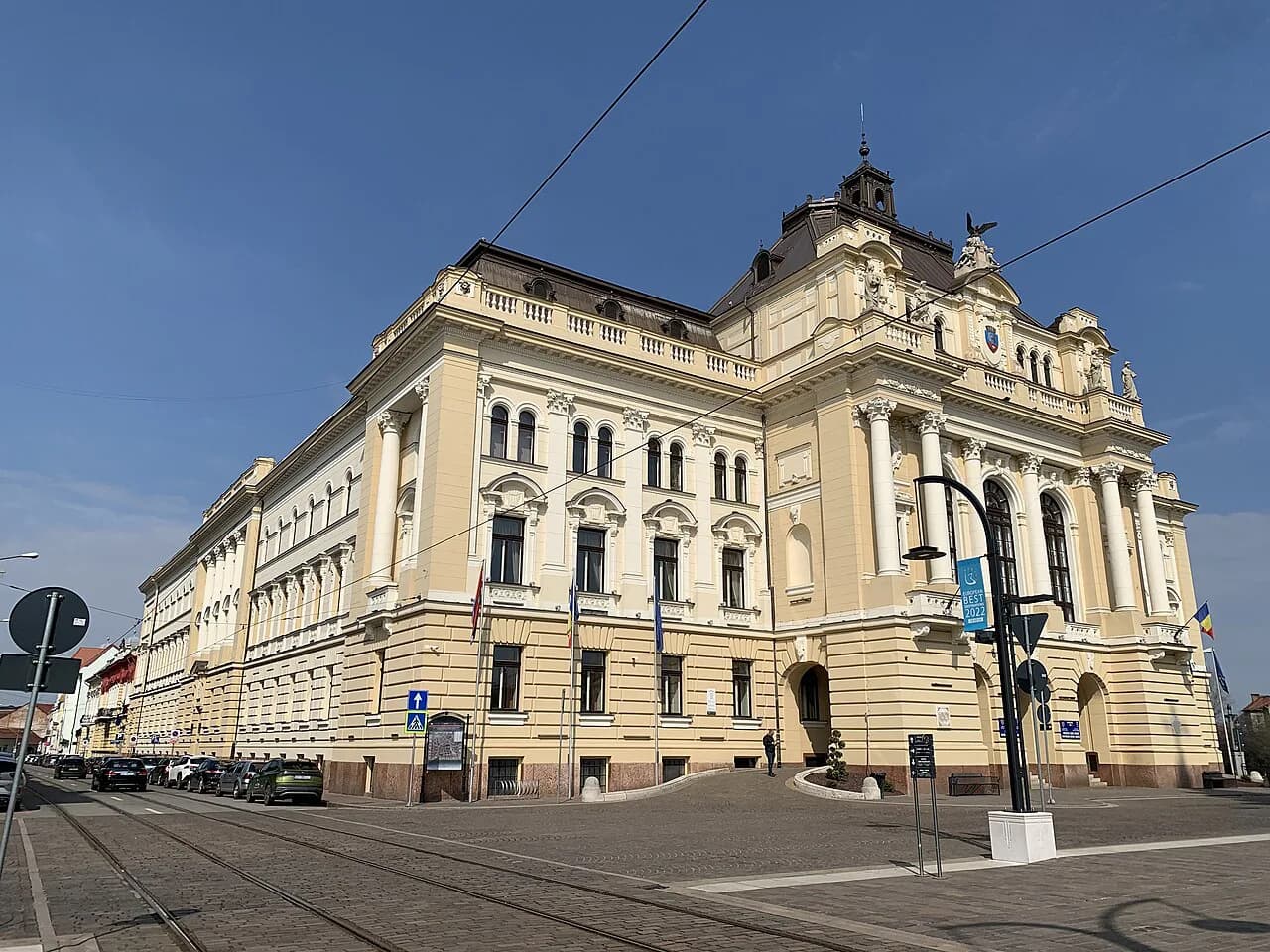
Four buildings do most of the work of defining Union Square, and all four went up within a few years of each other at the turn of the twentieth century. Oradea City Hall was built between 1901 and 1903, the Palace of the Greek-Catholic Bishopric between 1903 and 1905, the Moskovits Adolf and Sons Palace between 1904 and 1905, and the Black Eagle Palace between 1907 and 1908.
Two of these, the City Hall Palace and the Bishopric Palace, share an architect, Kálmán Rimanóczy Jr., and form the western front of the square. Standing back and comparing them is the quickest way to see how the same hand handled two adjacent commissions.
The Black Eagle Palace, Vulturul Negru, is the building most visitors photograph, with an Art Nouveau frontage and a glass-roofed arcade behind it. Its interior passages are worth a few minutes even if you are not stopping to eat.
The square holds seven architectural styles in one view, from Baroque through Classicist, Eclectic and Secessionist to Neo-Romanian, which is why a slow circuit beats a quick snapshot. Read the fronts as a sequence rather than a single facade.

The three churches on the square
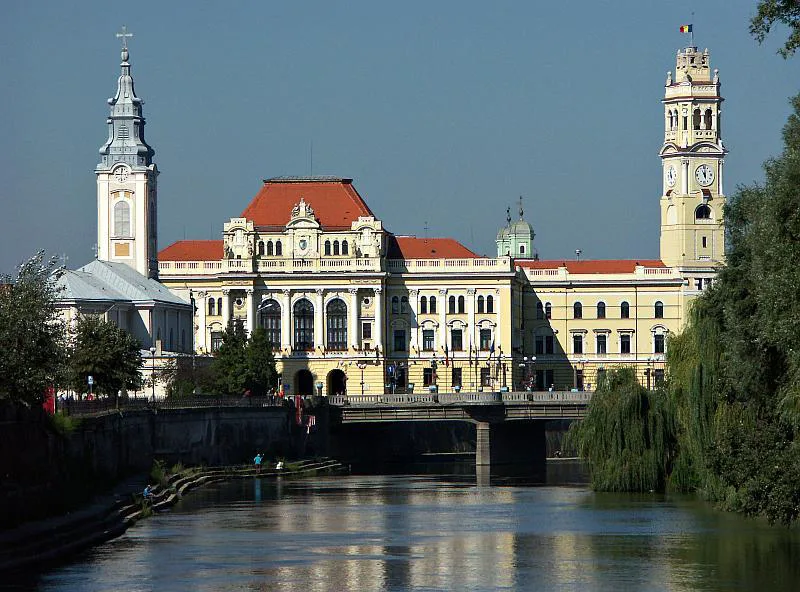
The Saint Ladislaus Church is the earliest of the three survivors, a Baroque building completed in 1733, and it anchors the square's northern side. The Moon Church, officially the Assumption of Mary Church, followed, with construction running from 1784 to 1832.
The Greek-Catholic Cathedral of Saint Nicholas, built between 1800 and 1810, closes the trio. These three were the only structures to survive the fire of 1836, which is the reason the square's older layer is ecclesiastical and its later layer is civic and commercial.
The Moon Church takes its name from its astronomical clock mechanism, which is the detail most people come to see. Step inside if the doors are open, and treat it as a short pause rather than a full sight in its own right.
Service times govern when you can go inside any of the three, so plan the interior visits around the doors being open and keep the exteriors as the fixed part of your circuit. Check the parish notice boards at each entrance for the current pattern.
How long to allow and where to sit
Give the square 45 minutes to an hour if you are walking a full circuit, reading the palace fronts and looking into the churches. Add another half hour if you want a coffee on the square, which is the way most people end up spending longer here than planned.
Seating is built into the layout, and after the 2015 rehabilitation the square works as a place to pause rather than a monument to file past. Benches, frontage cafés and the open paved centre let you alternate looking with sitting.
The square fills up on warm evenings, when the cafés spill out and the paved centre becomes the busiest part of the city. Coming earlier in the day gives you clearer views of the building fronts and an easier walk round.
There is no gate to pass for the square itself: Oradea Heritage describes it as a public square that you simply walk into. Opening hours and entry rules belong to the individual buildings and museums around it, not to Piața Unirii.
What is within a few minutes' walk
The City Hall Tower rises directly off the square, and the Oradea City Museum sits in the city centre, so you can pair the exterior circuit with an indoor visit. Check the current opening days and ticket prices at the entrance or on the museum's own pages before you build a day around it.
Oradea Fortress, Cetatea Oradea, is a short walk from the square across the Crișul Repede, and it makes the natural second stop of a half-day in the centre.
The Sion Neolog Synagogue and the Darvas-La Roche House sit within the same central cluster, so a single morning covers the square and one or two of them without any transport. Pick according to whether you want Art Nouveau interiors or synagogue architecture.
The Oradea Zoo is a separate trip rather than a walk from the square, so keep it for an afternoon with children rather than tacking it onto a city-centre circuit.
Seeing the square with the rest of the city
Treat Union Square as the anchor of a walking day in Oradea and build the rest of the route outward from it: fortress, synagogue and the Art Nouveau houses all sit within a comfortable radius. That way the square is the fixed point you return to rather than one stop on a checklist.
Oradea Heritage keeps an office in the city at Iosif Vulcan 11, open Monday to Friday from 8am to 4pm and closed at weekends. That is an address for enquiries about the buildings it maintains, not a visitor centre on the square, so do not plan your day around it.
Photographers get the best of the palace fronts in flat, even light, when the detail of the Secessionist and Eclectic facades reads clearly. Midday sun on the paved centre is harsh, so work the shaded edge of the square instead.
Is Union Square worth an hour of your Oradea day?
Yes, and it should be the first hour rather than the last: the square explains the rest of central Oradea, because the City Hall, the Black Eagle Palace, Oradea Fortress and the other nearby sights all sit within a short walk of it. Walk the perimeter once, look into the three churches, then sit down and let the architecture do the rest.
Before you go, confirm the opening days and any entry charges for the City Hall Tower and the churches on their own listings, since those rules belong to the buildings rather than the square. The square itself needs no ticket and no booking.
Frequently Asked Questions
Is Union Square the same as Piața Unirii in Oradea?
Yes. Piața Unirii is the Romanian name for Union Square, and the two are the same paved public square in the centre of Oradea. Older maps and signs may also call it Small Square, Ferdinand Square or Saint Ladislaus Square, all names the square has carried over time.
Do you need tickets to visit Union Square?
Union Square is a public square you walk into freely. Entry charges may apply if you go inside one of the buildings around it, such as the City Hall Tower or the Oradea City Museum, so check those separately at the entrance.
How far is Union Square from Oradea Fortress?
Oradea Heritage places Unirii Square on the left bank of the Crișul Repede, in the city centre. Oradea Fortress is a short walk across the river, close enough to combine both in a single half-day on foot. Allow the fortress its own block of time rather than treating it as a five-minute add-on.