
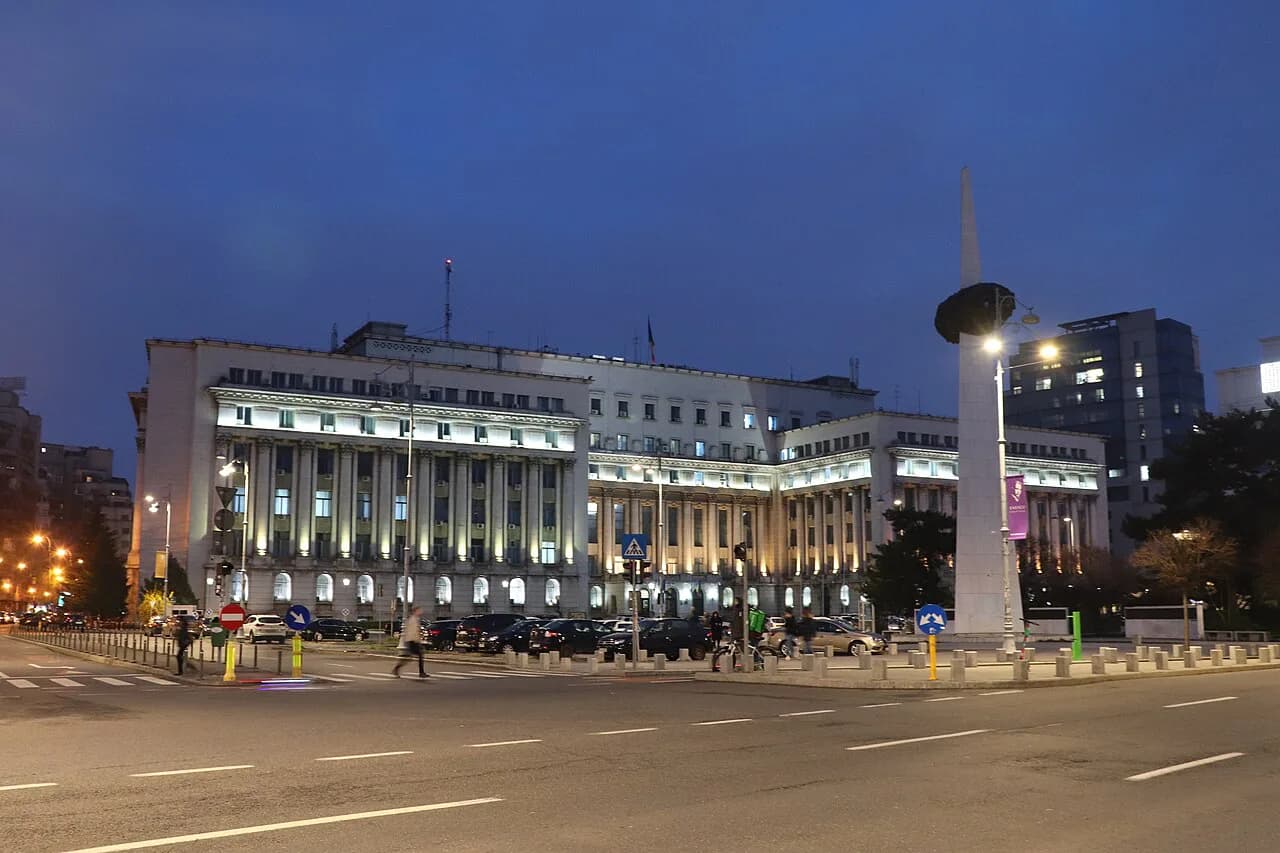
Revolution Square (Piața Revoluției), Bucharest: What to See and How Long It Takes

Revolution Square (Piața Revoluției) is a free, open public square in central Bucharest and needs roughly 30 to 45 minutes of your time. Come for the Rebirth Memorial, the balcony where Nicolae Ceaușescu gave his last public speeches, and the ruined Securitate shell on Str Dobrescu. This page maps out each element, tells you which side of the square to stand on, and explains how to reach it on foot or by Metro.
What Revolution Square is and where it sits on Calea Victoriei
The square sits about two-thirds of the way down Calea Victoriei, at the corner with Str Dobrescu, in the middle of Bucharest. Until 1989 it was called Piața Palatului, named for the former Royal Palace on the square that now houses an art museum; it took its present name from the revolution that began here.
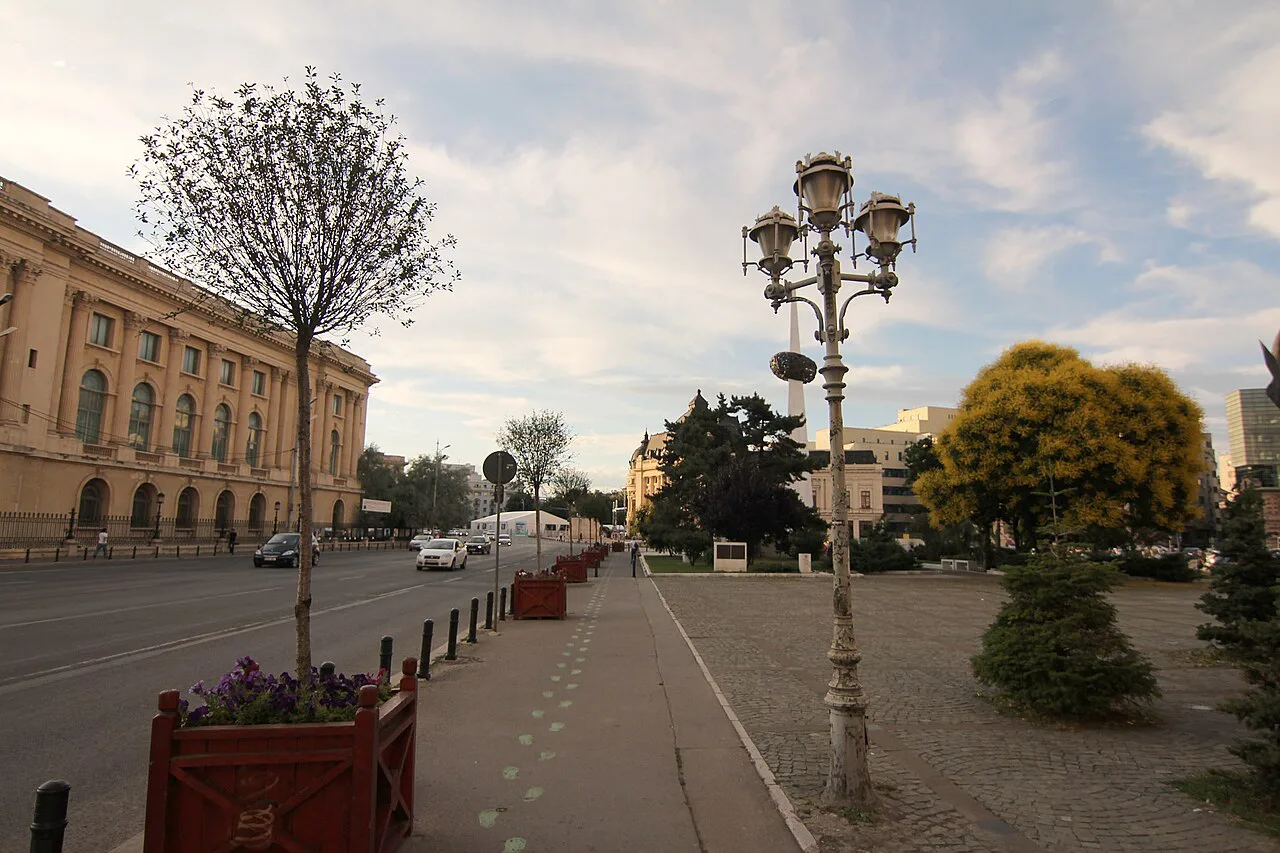
Treat it as a place to stop rather than a sight to tick off: the memorials, the government buildings and the church sit around an open expanse of paving with traffic on two sides. The Royal Palace frontage now belongs to the National Museum of Art of Romania, so a visit can combine a look at the square with a gallery stop.

How to get there: walking from central Bucharest and the nearest Metro
Walking is the easiest approach from anywhere in central Bucharest, and the nearest Metro station is at Piața Universității, a couple of blocks away. Access to the square and its monuments is free and obvious once you arrive.
If you are working through the city's sights in one day, the square fits naturally between the Old Town and the northern end of Calea Victoriei. Our guide to Bucharest Attractions: 13 Visitor Guides sets out the wider spread of sights so you can judge the walking order.

The Rebirth Memorial (Memorialul Renașterii) and the memorials at its foot
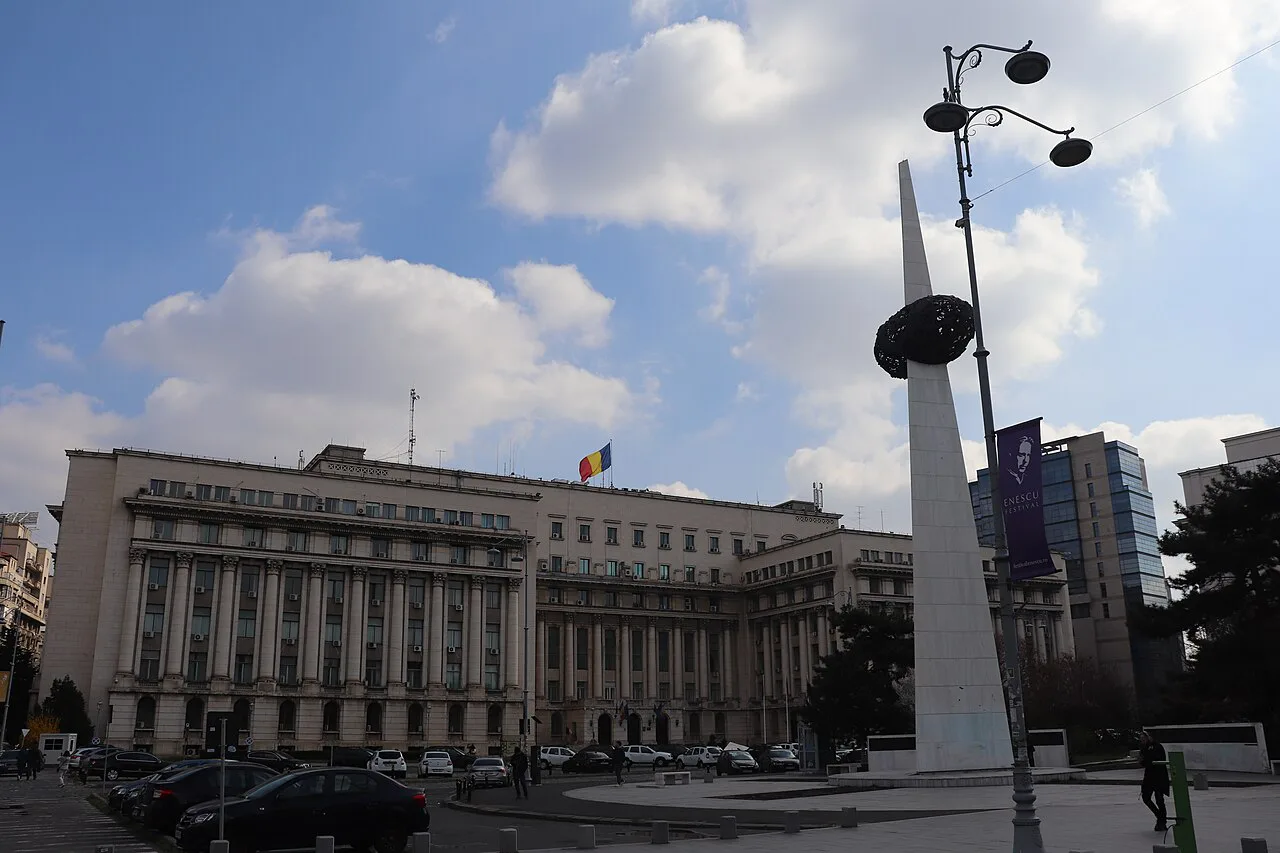
The official focal point in the centre of the square is the Rebirth Memorial (Memorialul Renașterii), erected in 2005 to mark the 1989 revolution. It takes the form of a thin white marble obelisk piercing a rounded bronze shape near its top, which has earned it nicknames including the potato of the revolution and the olive on a toothpick.
At the foot of the obelisk you will find a group of bronze figures and two curved concrete walls with the names of victims inscribed in bronze. Stand here first, because the layout of the rest of the square reads more clearly once you have seen the memorial to the dead.
The former Central Committee building and the balcony where Ceaușescu last spoke
The building behind the memorials now houses the Ministry of the Interior, but until 1989 it held the Central Committee of the Communist Party. It was from the front balcony of this building that Nicolae Ceaușescu made his last two public appearances and was shouted down, and from the roof of its right wing, facing it, that he was evacuated by helicopter shortly before revolutionaries reached the building.
Face the building to orient yourself: the memorials sit in front of it, and the balcony is the point to look up at. It is a working government building, so you view it from the pavement rather than going inside.
Bullet marks and the memorial to the martyrs of December 1989
Fighting broke out in the square between protesters and the military, and you can still see pockmarks from bullets on some of the surrounding walls. Look at the facades as you walk the perimeter rather than only at the monuments in the middle.
Directly in front of the former Central Committee building stands a low white marble pyramid honouring the martyrs of December 1989, its tip pointing towards the balcony. The plain shape is a deliberate contrast with the more elaborate Rebirth Memorial a short distance away.
The ruined Securitate shell on Str Dobrescu and IO Coffee Bar
On the left side of the square, on Str Dobrescu, a striking structure stands out: the shell of the destroyed former Securitate building, out of which rises a modern glass-and-steel edifice. This is the detail most visitors miss, and it is a few steps from the main memorials.
The building's basement and ground floor hold a cafe called IO Coffee Bar, where large black-and-white photographs of the revolution days are blown up on the walls. Go in for the pictures rather than the drinks: they show damaged buildings, tanks, soldiers with machine guns and the Securitate building before its destruction.
The Iuliu Maniu statue, the Coposu bust and the memorial behind Cretulescu Church
Behind the memorial group stands a statue of the politician Iuliu Maniu, prime minister between 1928 and 1933, along with what looks like a bronze sculpture of a dead tree. On the other side of the square, next to the Orthodox Cretulescu Church, is a memorial bust to the anti-Communist activist Corneliu Coposu, imprisoned for a total of 17 years by the early communist regime and later a campaigner against the old communists' role after 1989 until his death in 1995.
Behind the church is another memorial to the martyrs of the revolution, so walk a full circuit of the square rather than stopping at the obelisk. The church itself gives you a quiet, built contrast to the political architecture around it.
How much time to allow and what is within a few minutes' walk
Allow 30 to 45 minutes to see the memorials, read the inscriptions and look at the bullet-marked walls; add a little extra if you go into IO Coffee Bar for the photographs. The square is compact, so the time goes on looking rather than walking between stops.
Within a few minutes on foot you reach Piața Universității and the lower stretch of Calea Victoriei, which puts the Romanian Athenaeum (Ateneul Român), Bucharest and the CEC Palace (Palatul CEC), Bucharest in easy reach.
If you are building a day of museums around the square, the National Museum of Art of Romania occupies the former Royal Palace frontage, and the National Museum of Romanian History, Bucharest is a short walk south along Calea Victoriei.
Tickets, opening hours and guided tours
The square and its monuments are free to enter and are not ticketed, so there is no queue to plan around and no closing time to work to. The buildings around it keep their own hours as working ministries and museums, so check each museum's own page before setting out.
Guided walking tours that cover Revolution Square are sold through Viator, including a three-hour private walking tour of the Old Town and its architecture, and GetYourGuide lists Communist-history tours in the square. Compare what each route actually includes before booking, since the square itself costs nothing to visit.
Is Revolution Square worth the stop?
Yes, if you give it half an hour and walk the whole perimeter rather than photographing the obelisk and leaving. The balcony, the bullet marks and the ruined Securitate shell carry the weight; the memorials in the middle only make sense once you know which building they face.
Pair it with the Athenaeum and the museums on Calea Victoriei, and save the heavier security checks for the Palace of the Parliament, Bucharest, which needs its own booking.
Explore more Bucharest guides
Frequently Asked Questions
Do you need tickets for Revolution Square in Bucharest?
No. The square and its monuments are free and open to walk through, and the guidebook describes access to the square and its monuments as easy and free. Guided walking tours that include the square are sold separately by operators, so check what a tour covers before paying for one.
How long should you spend at Piața Revoluției?
Plan on 30 to 45 minutes for the memorials, the inscriptions and the walls marked by bullets, plus a little extra if you stop in IO Coffee Bar on Str Dobrescu to see the revolution photographs.
Which Metro station is closest to Revolution Square?
Piața Universității is the nearest Metro station, a couple of blocks from the square. From there the square is an easy walk, and it also sits about two-thirds of the way down Calea Victoriei.