Putna Monastery: Stephen the Great's Church and Museum
Putna Monastery in Bucovina: the church where Stephen the Great is buried, his crown and sword in the museum, the courtyard towers and the free car park outside.
On this page
Putna Monastery gives you two things in one stop: a working monastery founded by Stephen the Great in 1466, and a museum holding his crown and sword. The courtyard and the church cost nothing; the museum is the only paid element. This guide covers what is inside the church, the objects in the museum, the towers around the courtyard and how to arrive by car.
Where Putna Monastery stands
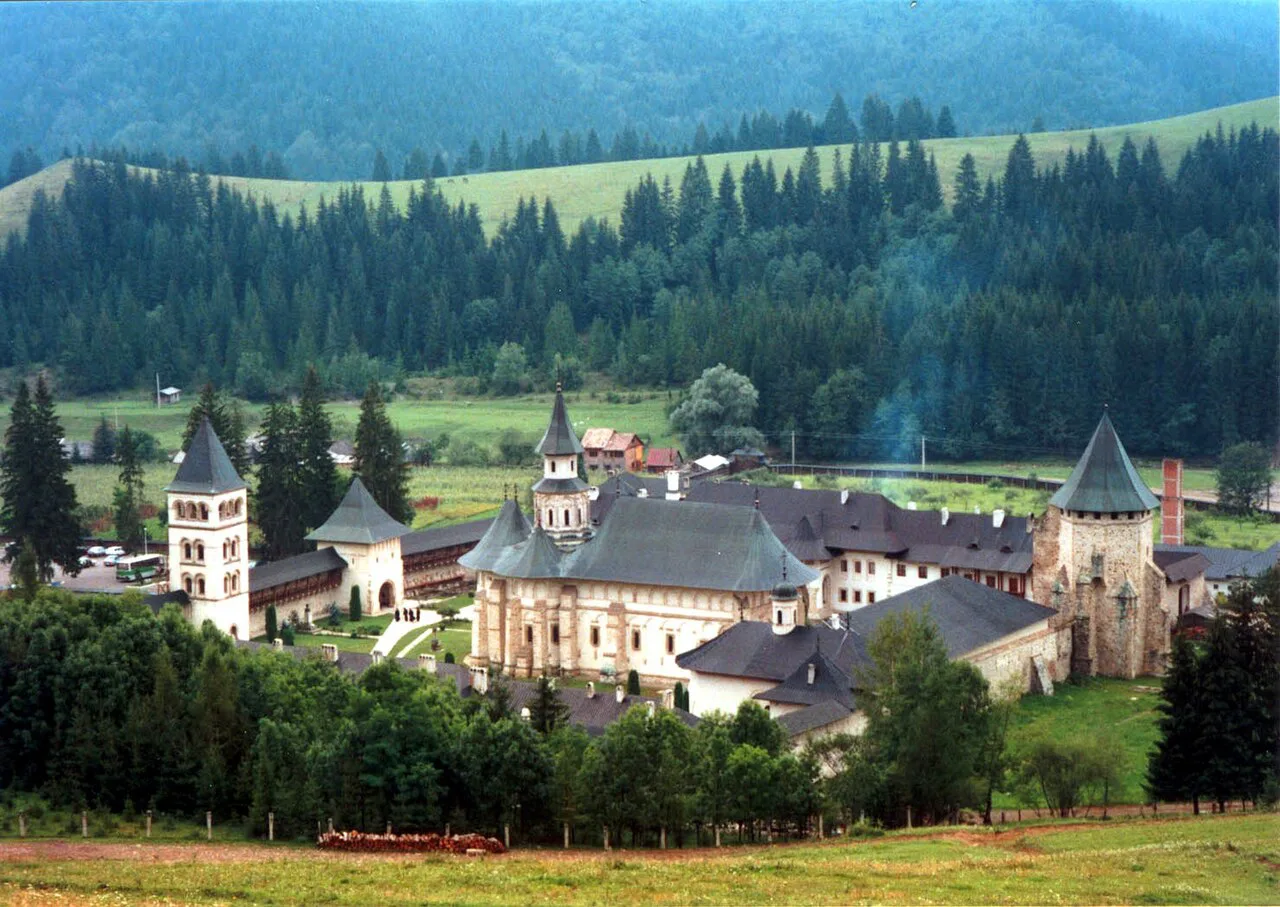
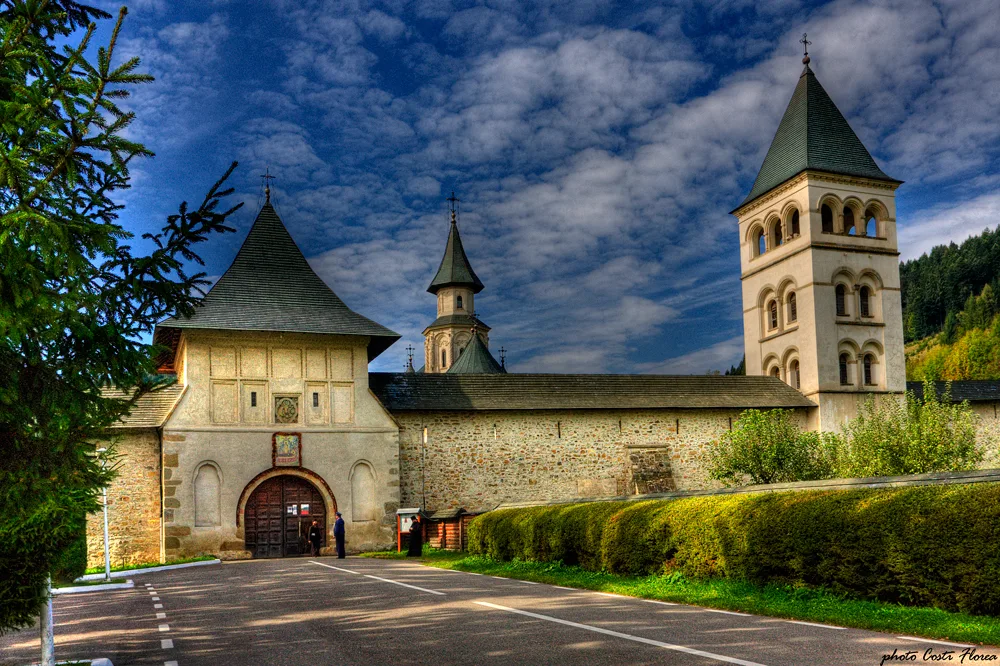
The monastery sits in Putna, Suceava County, on Ștefan cel Mare Street. The main street runs through a carved Maramureș-style gate and leads straight to a large free car park at the entrance. If you are driving yourself, this is a straightforward arrival on the Bucovina monastery circuit.
Putna is a monastery of Bucovina with a fortified enclosure, though its church exterior is not painted in the same way as Voroneț or Sucevița. The monastery was founded at the behest of Daniil Sihastru and dates from 1466, and it was consecrated three years later. It is a historical monument and is still inhabited by monks, so treat the church as a place of worship first.
Opening hours and what costs money
The monastery can be visited daily between 6 and 19. The monastery courtyard and the church are free, while the museum costs 5 ron; check the current lei figure at the entrance before you budget, since ticket prices change. A visit here is therefore one of the cheapest stops on a Bucovina monastery route.
The monastery publishes its own service schedule separately from visitor opening hours, so do not read the liturgy times as the hours the site is open to tourists. If you want to attend a service rather than simply look around, check the monastery's own programme before you travel. That separation matters on feast days, when the church is busy with worshippers.
The church of the Assumption from outside
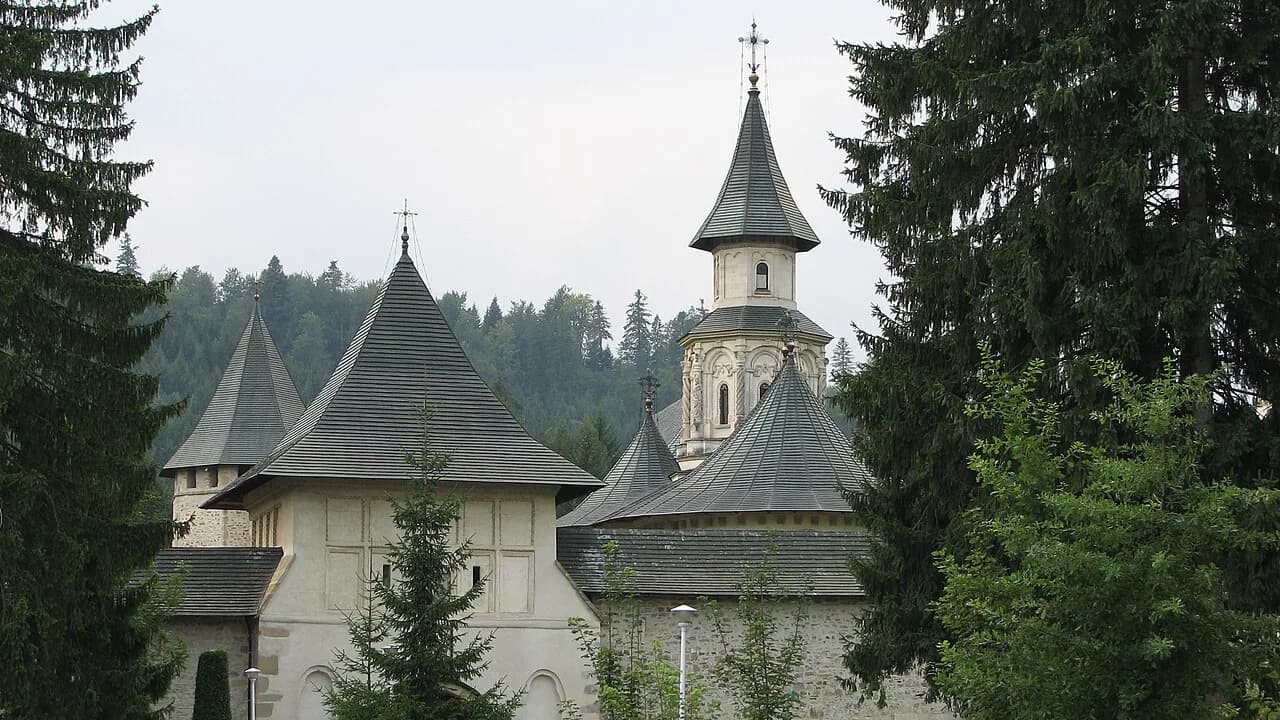
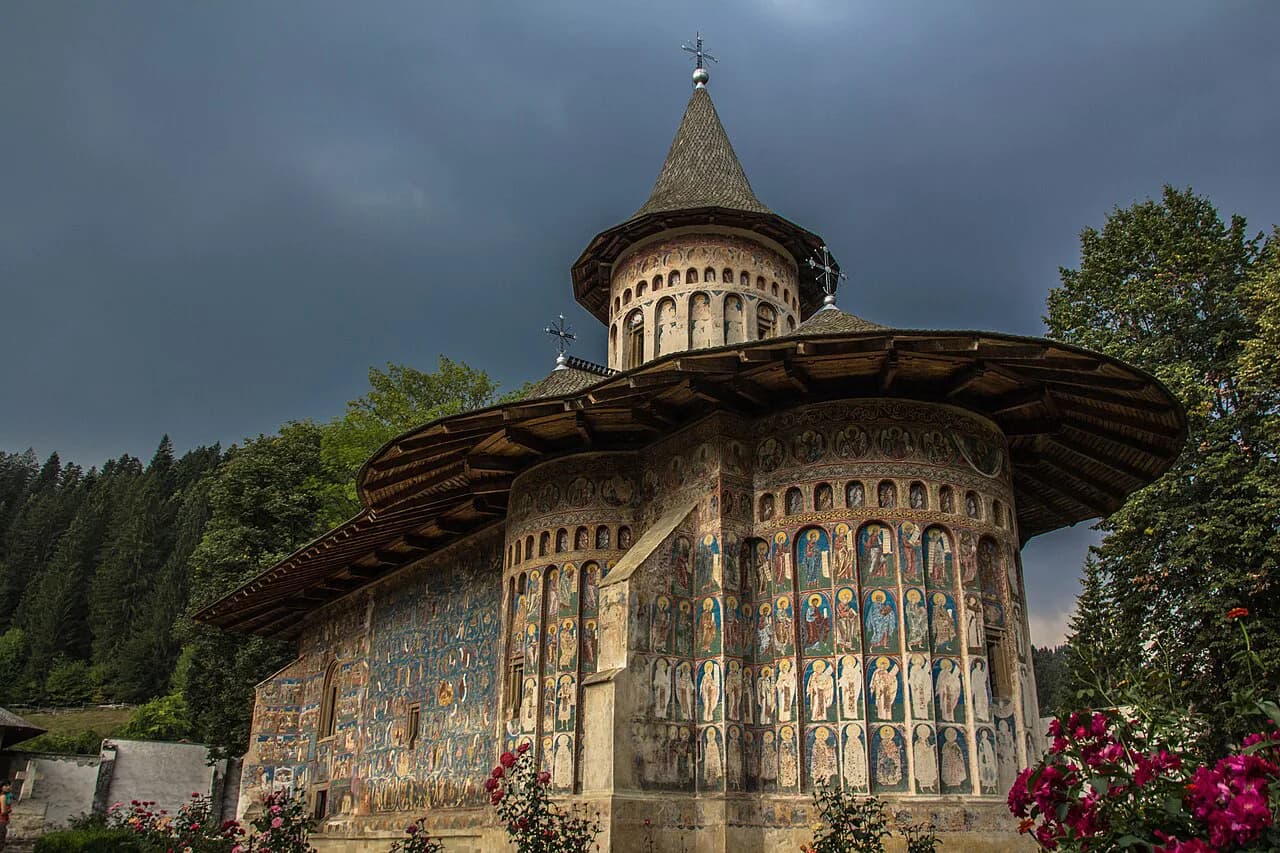
The church is dedicated to the Assumption of the Blessed Virgin and is Orthodox. Gothic elements show in its architecture, and the exterior is framed by a girdle motif that symbolises the Most Holy Trinity; the same motif appears inside. Look for the girdle band before you go in, because it is easy to walk past on the way to the door.
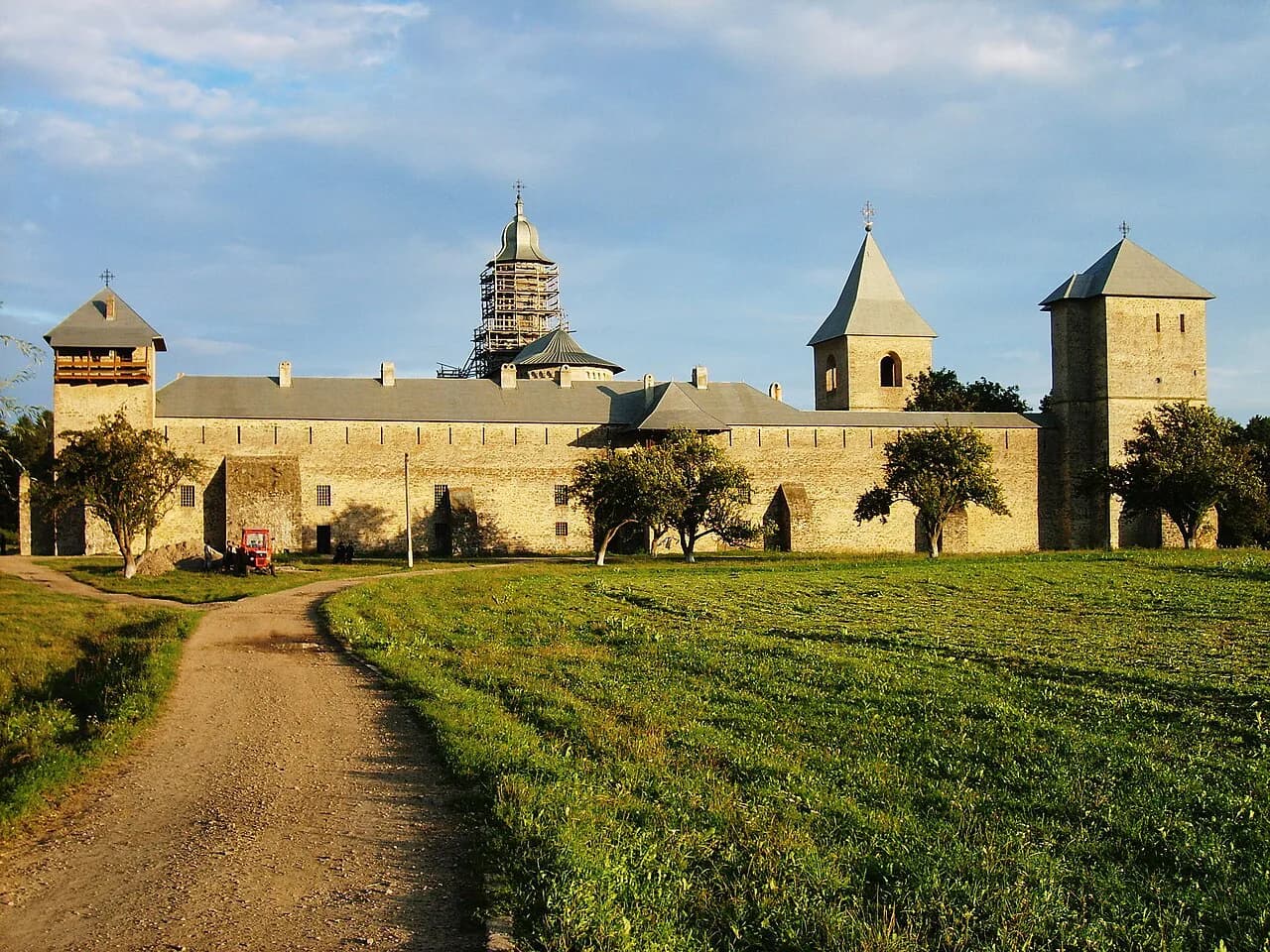
A thick stone enclosure wall with several towers surrounds the monastery, so the church is seen first across a courtyard rather than from the road. That layout slows you down: you pass the gate, the walls and the towers before reaching the church door, which is part of why a short stop feels rushed here.
Inside the church: the tombs
Inside the church are the tombs of Stephen the Great, his wives Maria de Mangop and Maria Voichița, his son Bogdan III, Ștefăniță-Vodă, Maria Cneajna, Maria the wife of Petru Rareș, and the Moldavian metropolitan Iacob Putneanul. Knowing the names turns a dark interior with stone slabs into a sequence you can follow. Give the church quiet time rather than treating it as a corridor to the museum.
At the ruler's tomb is a massive silver urn placed here by students from Vienna, among them the national poet Mihai Eminescu. It is a small object with a long afterlife in Romanian memory, and it is easy to miss if you are looking only at the carved slabs. Find the tomb first, then look for the urn.
The courtyard, walls and towers
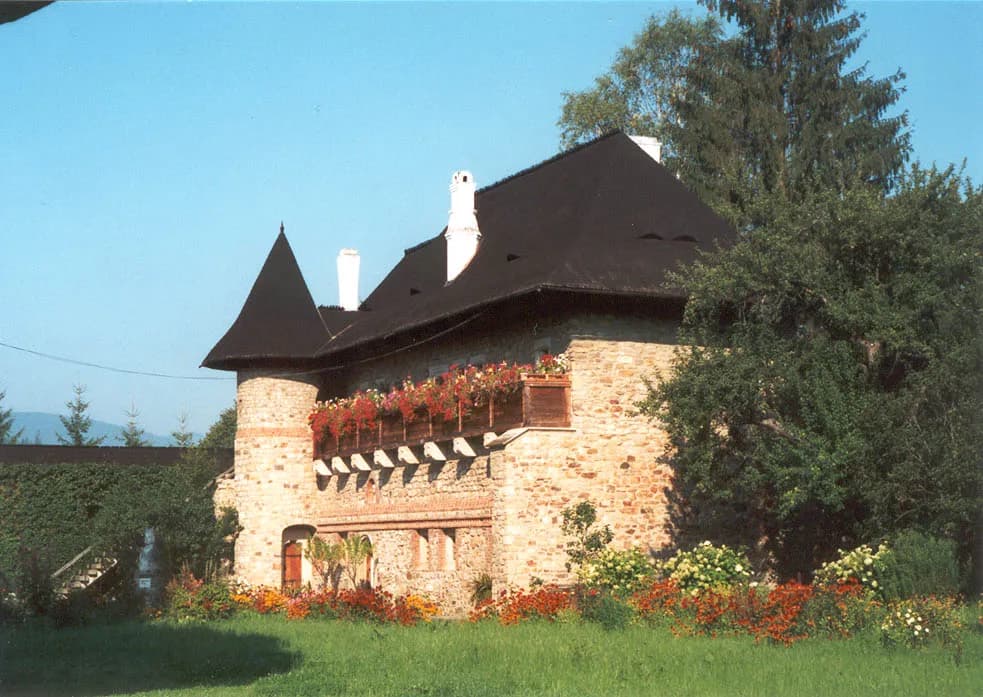
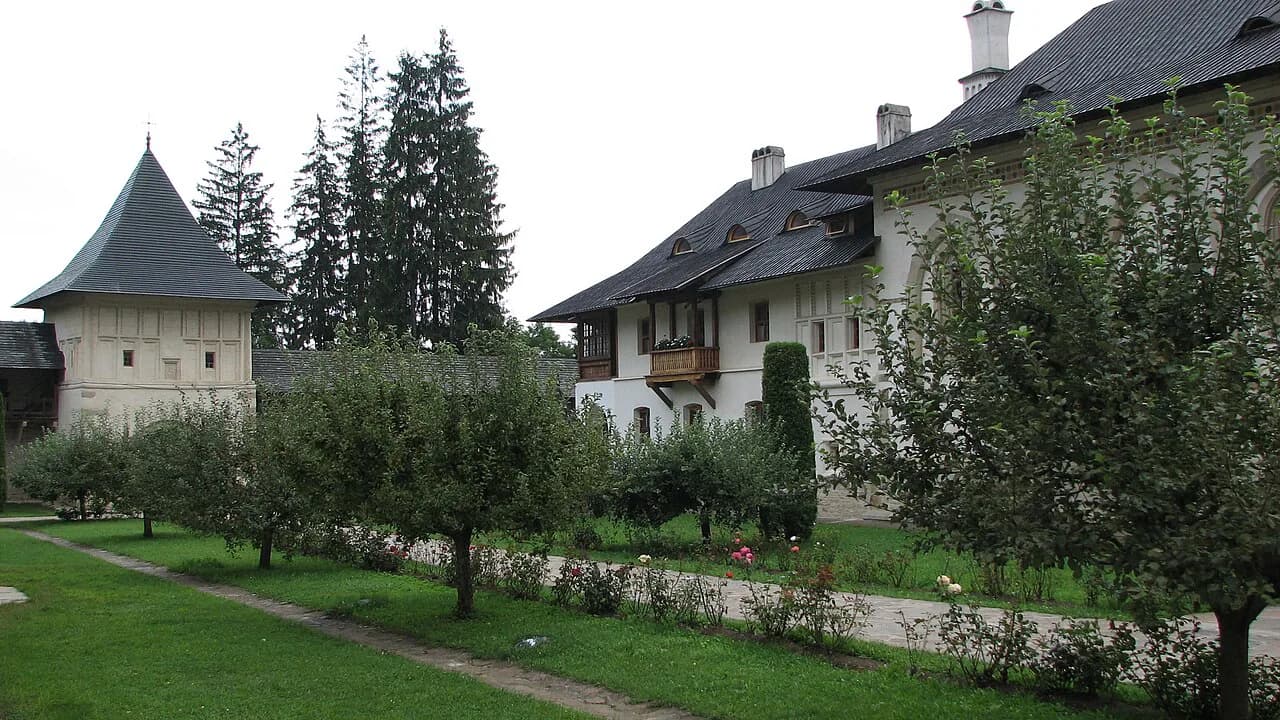
The entrance tower is the Mihai Eminescu Tower, carrying the coat of arms of Moldavia and the year 1471 above the doorway. Other towers are the Treasury Tower, built in the time of Stephen the Great, and the Bell Tower. In the courtyard you will find a bust of the poet Eminescu and, nearby, the fountain of Saint Jacob Putneanul, and a paraclis built by Jacob Putneanul forms part of the ensemble.
Allow a few minutes to walk the wall line rather than heading straight for the church door. The towers give you the monastery's shape and its defensive logic, and they photograph better in flat light than the dark interior. This is also where you get your bearings before deciding whether the museum is worth the ticket.
The museum: crown, sword and embroideries
Behind the church, the Putna Monastery Museum is set out over two floors inside the courtyard. It preserves manuscripts, icons, the ruler's crown and sword, the Moldavian setm, the Tetraevangelion of 1473, silverware, and a collection of embroideries from the time of Stephen the Great. Two of the embroidered pieces are the grave covering of Maria de Mangop, showing the Crucifixion, and that of Stephen the Great, showing Stephen the Great and Maria Voichița.
The museum is the one paid element here, and it earns its keep if you care about textiles and metalwork rather than only architecture. If your time in Bucovina is short, the embroideries are the reason to go in; if you are collecting monasteries by exterior, you can reasonably skip it. Pair the visit with the wider Painted Monasteries of Bucovina route so you see how Putna differs from the painted churches.
Getting there and where Putna fits
By car, the approach is straightforward: the main street of Putna brings you to the carved gate and the free car park, so you do not need to hunt for parking in the village. Public transport in this part of Suceava County is limited, so check options before a long journey; the monastery's own site is the place to confirm any access arrangements. Read the town as a small settlement wrapped around one large religious complex.
Putna works best as part of a loop with the other painted monasteries rather than as a standalone day out from Suceava. If you are basing yourself in southern Bucovina, Câmpulung Moldovenesc and Gura Humorului are natural staging points for the monastery circuit, and Voroneț Monastery is the obvious next stop after Putna.
How long to allow
Count on around an hour and a half for the church, the courtyard towers and the museum at an unhurried pace, and closer to an hour if you skip the museum. The church rewards slow looking because the tombs are spread across the interior and the inscriptions are not obvious at a glance. If you arrive near midday, do the museum first while your eyes are fresh and the church afterwards.
Add travel time between monasteries rather than squeezing Putna and two more sites into one afternoon. Bucovina roads are slow, and the value of this stop lies in the detail inside the buildings, not in the number of gates you pass through. If you only have one day for the circuit, pick Putna plus one painted church and do both properly.
Is the museum at Putna worth the ticket?
Yes, if embroidered grave coverings and the crown and sword of Stephen the Great mean something to you; the ticket is small and the collection sits right behind the church. If you are monastery-hopping for painted exteriors, the free courtyard and church are the essential part and the museum is optional. Either way, arrive with the tower names in mind so the courtyard does not blur into the next stop.
Explore more Bucovina guides
Frequently Asked Questions
Is Putna Monastery free to visit?
The monastery courtyard and the church are free, and the museum costs 5 ron. The monastery can be visited daily between 6 and 19. Confirm the price and hours at the entrance before you budget, as these details can change.
Where is Stephen the Great buried?
Stephen the Great is buried inside the church of the Assumption at Putna Monastery, which he founded in 1466. Around his tomb are the graves of his wives Maria de Mangop and Maria Voichița, his son Bogdan III, Ștefăniță-Vodă, Maria Cneajna, Maria the wife of Petru Rareș and the metropolitan Iacob Putneanul. A silver urn placed here by students from Vienna, among them Mihai Eminescu, stands at the ruler's tomb.
Sources
Useful notes for your next trip
Optional updates to our guides.
You might also like
Continue reading
More guides you'll find useful