Painted Monasteries of Bucovina: Which Ones to Visit
Plan a Bucovina painted monasteries trip: Voroneț, Sucevița, Moldovița and Humor, what each exterior fresco shows and how to link them by car or on a tour.
On this page
See Voroneț, Sucevița, Moldovița and Humor if you have one day, in that order of priority, and add Putna and Suceava's own sights with a second day. Each of the four has a distinct exterior wall that rewards a different kind of attention, so the loop is not four versions of the same visit. This guide explains what survives on each facade, how to link the monasteries by car from Suceava, how long to allow at each stop, and what a guided day costs.
The monasteries sit in the forested foothills of the Eastern Carpathians in northern Romania, in the region known as Bucovina. They are Moldavian churches of the 15th and 16th centuries, painted on the outside as well as within, and several are recognised by UNESCO. Their walls work as large open-air biblical canvases, and the overhanging timber eaves above them are built to keep mountain rain off the plaster. If you want to widen the lens beyond this region, Monasteries in Romania: Painted Churches, Etiquette and Routes sets out the painted church tradition across the country.
What the painted monasteries of Bucovina are
The exterior frescoes were painted to carry religious narrative to people who could not read, in a period of Ottoman pressure on the region. The churches were founded under Prince Stephen the Great and his successor Petru Rareș, which is why the same handful of princely names recurs at each site. The painting mixes Byzantine iconography, Gothic architectural lines and local detail, and it has sat on the outside of these churches for roughly five centuries.
What makes them worth a journey rather than a single stop is that the outside painting covers whole walls, not panels. The eaves throw a shadow line across the top of the plaster, and the frescoes read as one continuous image rather than a set of framed scenes. You are looking at the building and the painting as a single object, which is why a slow look beats a photo stop.
Treat the monasteries as working religious sites first and visitor attractions second. Dress and behaviour expectations at Orthodox churches apply, and the painted walls are the church itself rather than a museum exhibit alongside it. For the wider region around them, see our guide to Bucovina, which sets the monasteries in the landscape of villages and forest they belong to.
Which monasteries to prioritise on a first trip
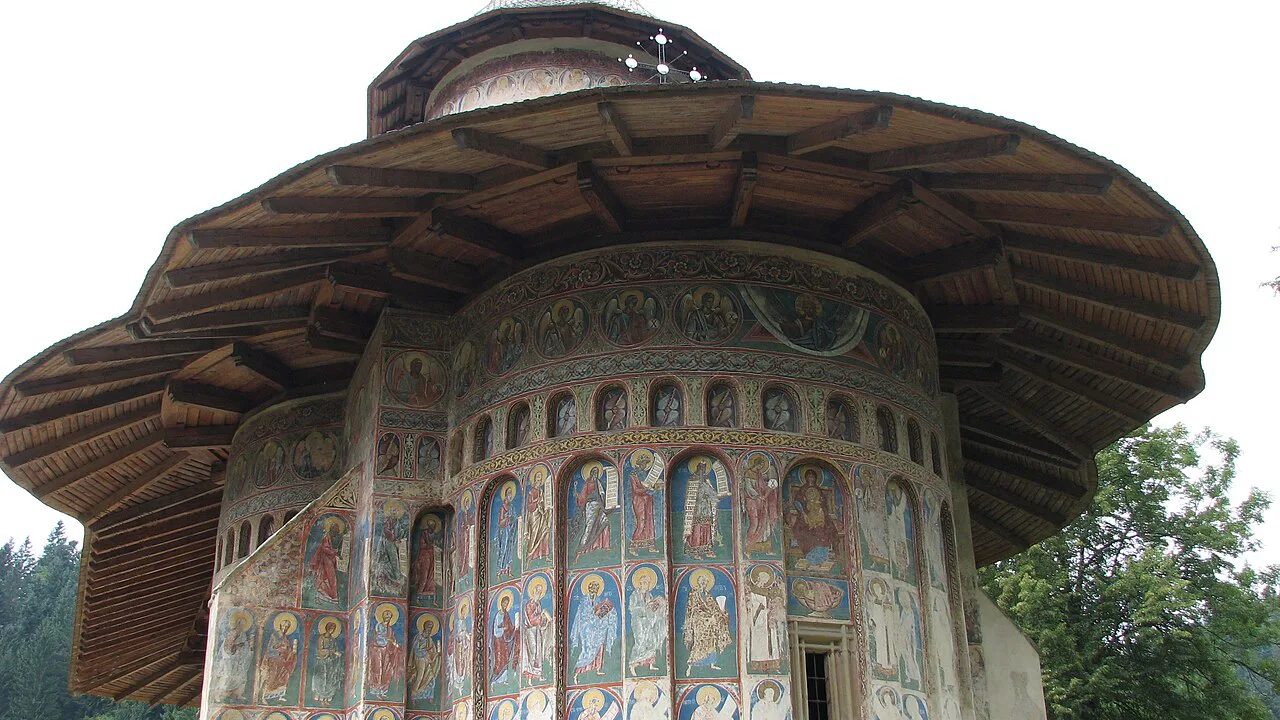
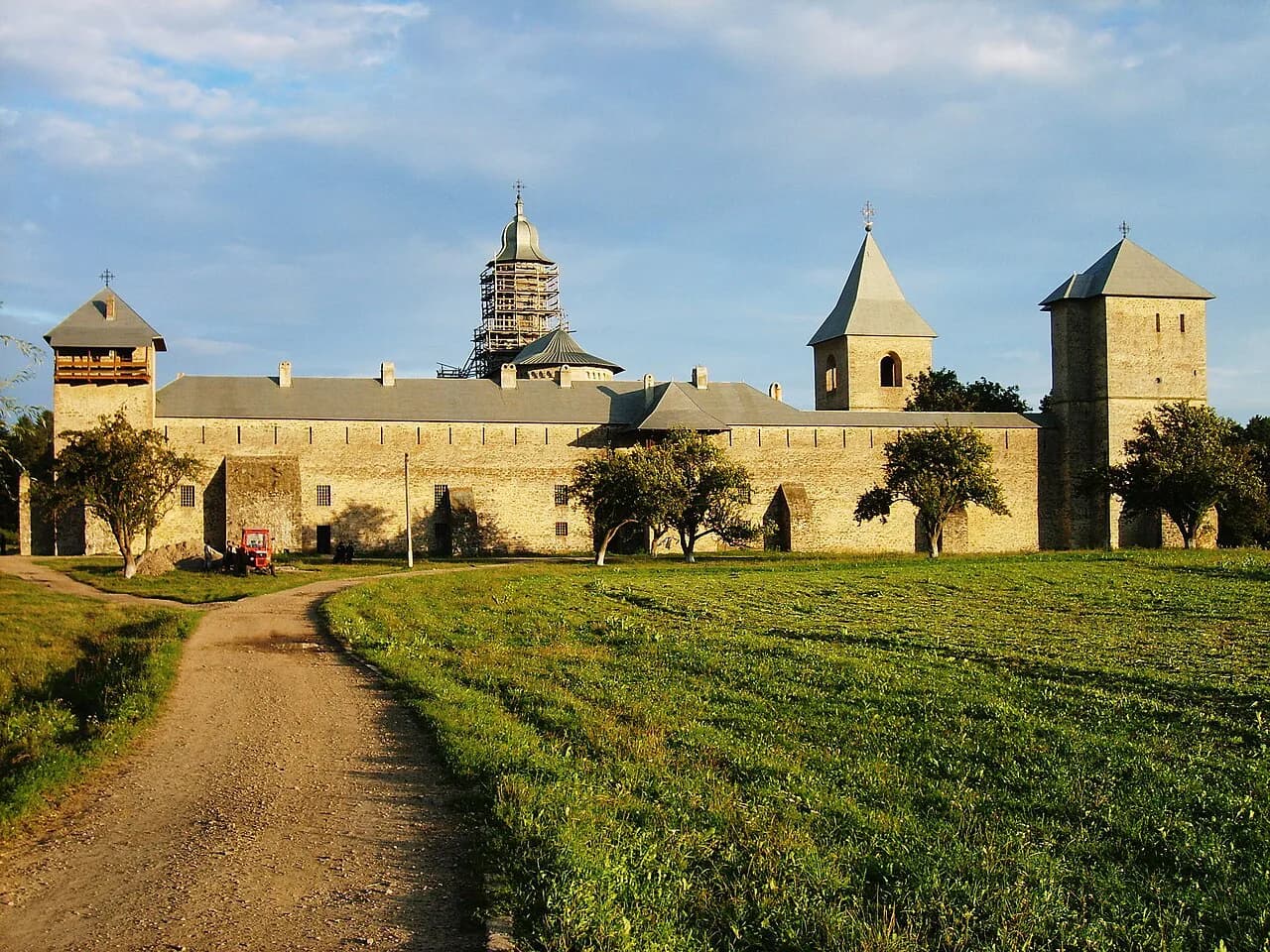
Voroneț is the one to keep if you cut everything else, because its west facade carries the great Last Judgment fresco across an uninterrupted surface. Sucevița is the one to keep if you care about fortification as much as painting, since the church stands inside defensive walls with corner towers. Moldovița gives you walls roughly 1.2 m thick and 5 m high with a gate tower, a golden-toned exterior and a historical fresco with a political reading, and Humor gives you a smaller church with an open portico and a freestanding wooden watchtower.
If you have only an afternoon, pair Voroneț with Humor: they are the two shortest visits and the contrast between the huge west wall and the modest portico church is the clearest introduction to what these buildings do. Save Sucevița and Moldovița for a full day, when you can look at the Ladder of Virtues and the Siege of Constantinople without watching the clock.
Voroneț Monastery: the west facade and the Voroneț blue
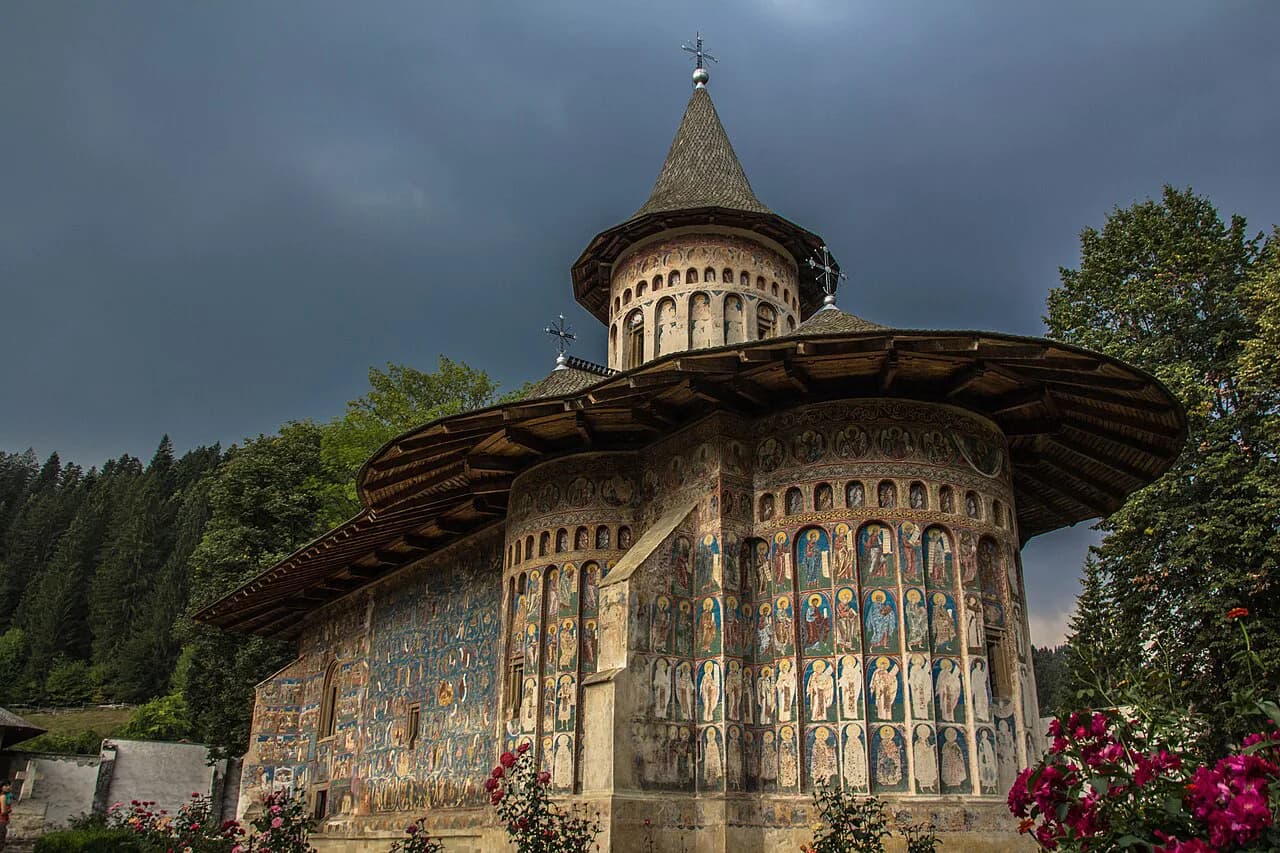
Stephen the Great built Voroneț Monastery in 1488 on the advice of his confessor Daniil Sihastrul, and the church went up in less than four months, between 26 May and 14 September of that year. The plan combines Byzantine and Gothic elements, with a clover-leaf foundation and a tower above the nave. The Voroneț Monastery guide covers the church itself, its painting and how to time the visit.
The west facade carries the Last Judgment, painted on a deep blue ground that specialists treat as unique and that is usually called the Voroneț blue. The same blue background holds the Tree of Jesse, the genealogy of Christ. Stand back far enough to take in the whole wall before you move close, because the composition is designed to be read at a distance first.
Arrive early if you want the west facade before the tour groups, because the light is at its best early on. Our Voroneț Monastery guide goes wall by wall, and Voroneț village is the base if you want to be at the gate before the coaches.
Sucevița Monastery: walls, towers and the Ladder of Virtues
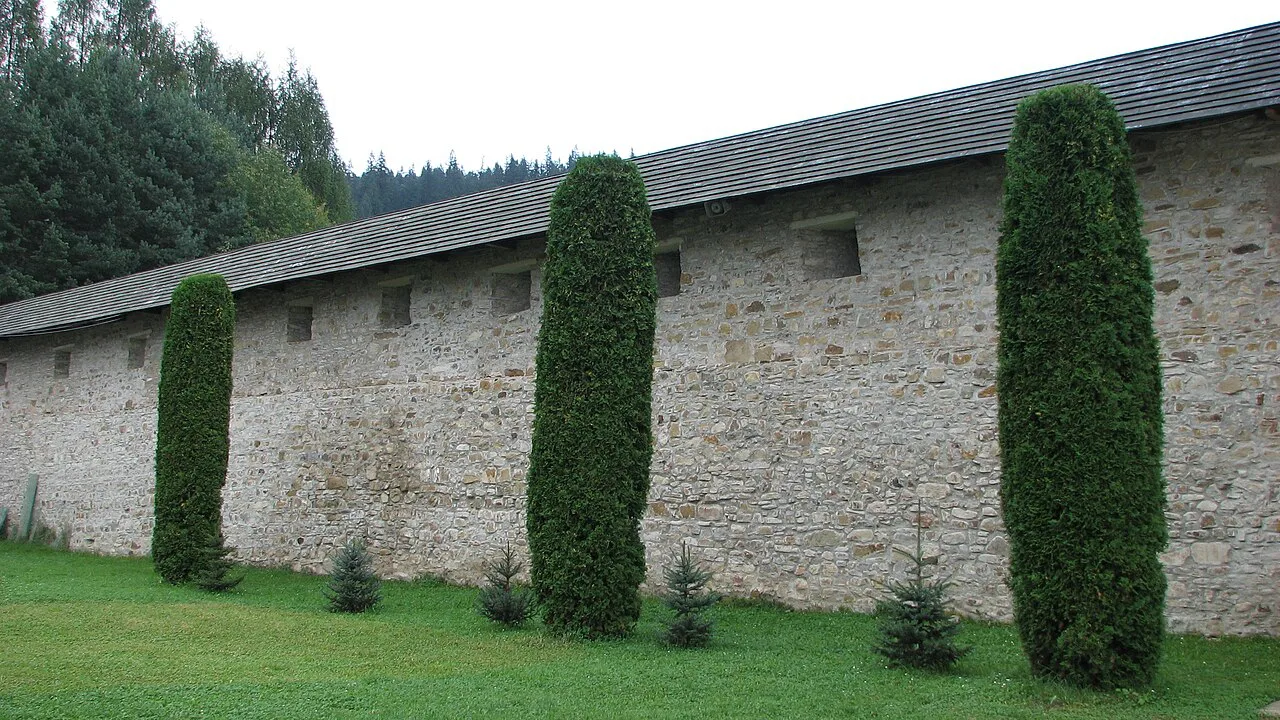
Sucevița Monastery stands in the village of the same name, on the Sucevița brook about 18 km south-west of Rădăuți, and it was built in the last decades of the 16th century at the expense of the Movilă family, with Ieremia as ruler of Moldavia from 1595 to 1606. The church is enclosed by thick defensive walls with fortified corner towers, so the approach is through a gate rather than straight into a courtyard. That enclosure changes the visit: you feel the site as a defended compound before you see the painting.
The exterior painting at Sucevița is the best preserved of the group of Moldavian churches with outside frescoes, and it is the only one that keeps its northern side. That north wall holds the Ladder of Virtues, a scene of angels and falling sinners that is the most striking image at the site. Because it faces north, it never takes direct sun, which is precisely why the colour has held.
Plan Sucevița for the middle of the day, when the north wall is evenly lit rather than in harsh contrast. If you are working to a tight schedule, this is the monastery where a guide earns their fee, because the Ladder of Virtues needs its sequence explained. The Sucevița Monastery guide goes wall by wall, and the Church of the Resurrection is the building to look for once you are through the gate.
Moldovița Monastery: the 1532 church and the Siege of Constantinople
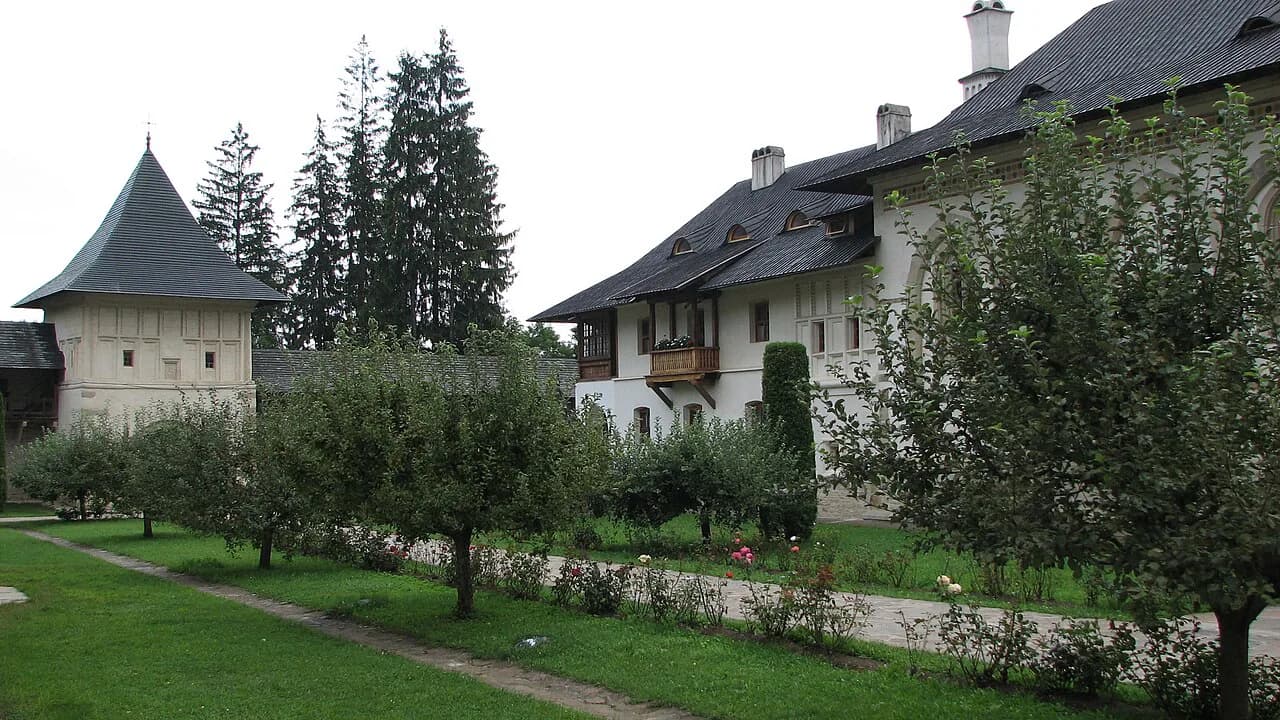
Petru Rareș founded Moldovița Monastery in 1532, and the church sits inside strong walls roughly 1.2 m thick and 5 m high, with towers at both corners of the facade and a gate tower. The aisle was extended by enclosing two further spaces, and the narthex windows are set symmetrically. The result is a church that looks as much like a small fortress as a place of worship.
The southern wall carries the Siege of Constantinople, a historical fresco showing Christian defenders holding off Persian and Avar attackers. Read as a veiled political allegory, it encouraged resistance to the Ottoman army of the day, which is what makes it more than a battle scene. The exterior palette runs to warm golden yellows, so the wall looks quite different from Voroneț's blue.
Moldovița is the stop most often squeezed when a day runs late, and that is a mistake if the Siege fresco is the reason you came. Give it a proper half-hour rather than ten minutes. Our Moldovița Monastery guide sets out the church and its painting in full.
Humor Monastery: the open portico and the wooden watchtower
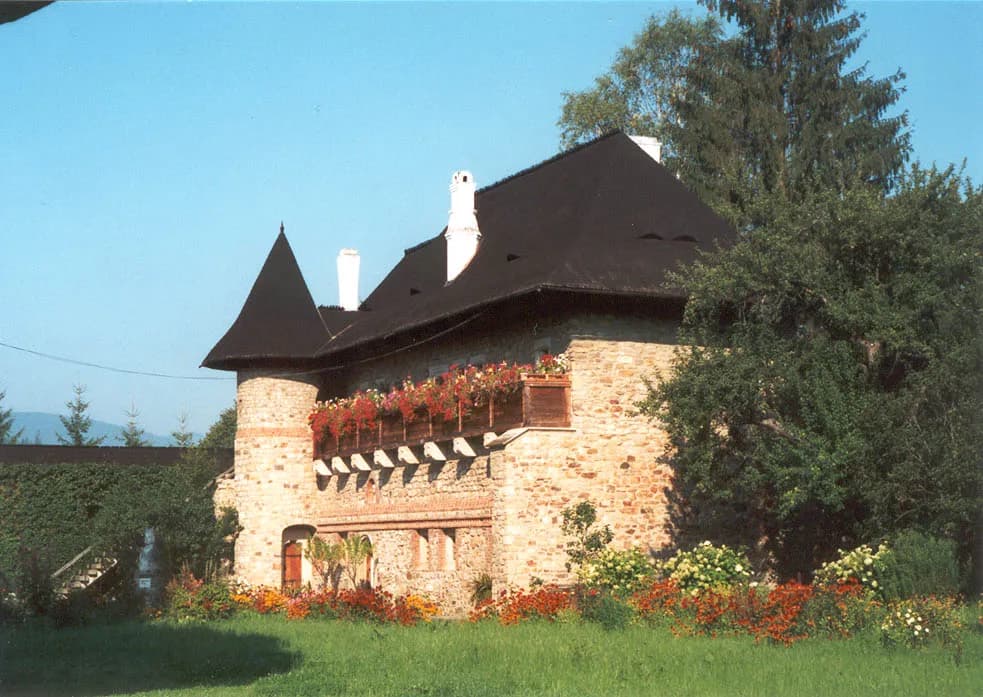
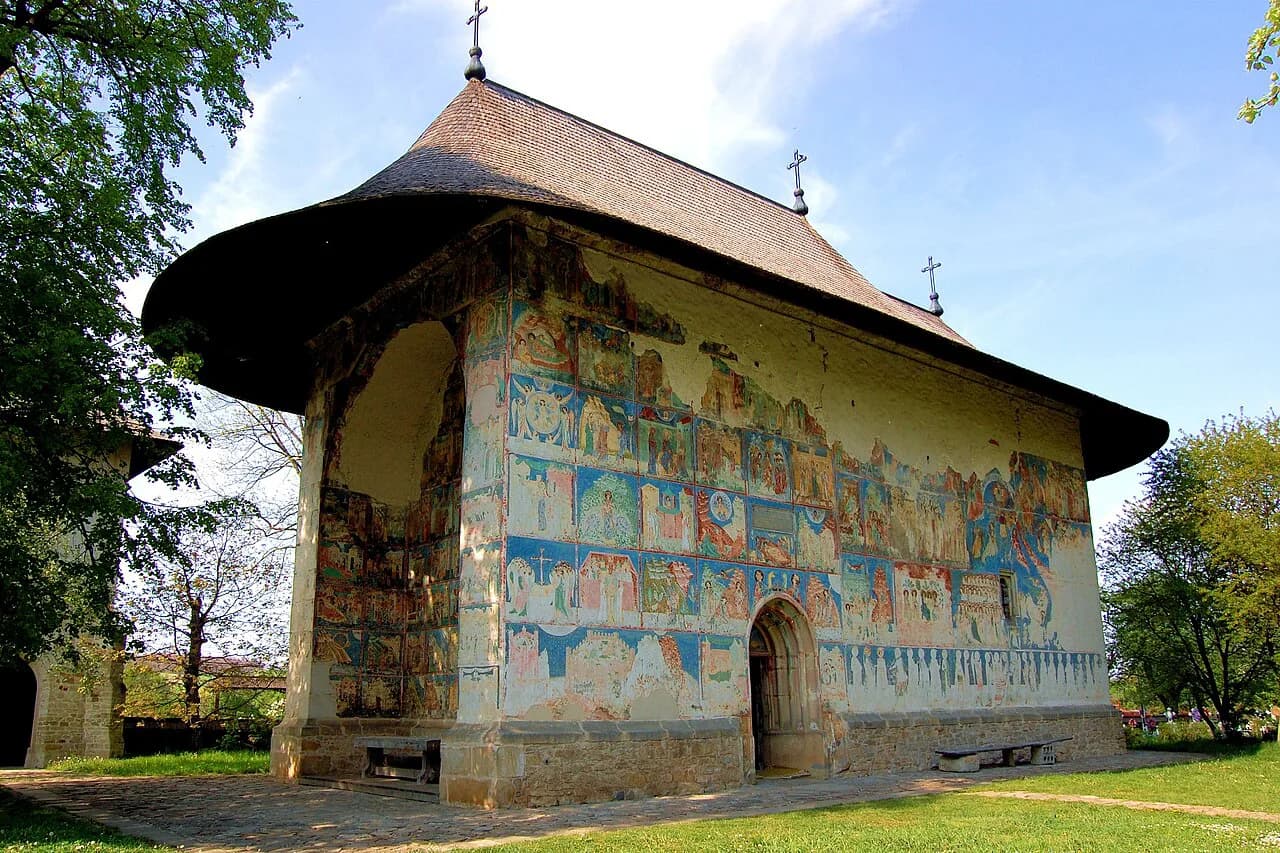
Humor was built in 1530 without a church tower, a feature reserved for princely foundations, and it is distinguished by an open portico supported on rounded arches. The exterior palette is a rich reddish-brown, warmer and smaller in scale than the big sites. A freestanding three-storey wooden defensive watchtower stands on the site and looks out over the surrounding apple orchards.
Because Humor is compact, it is the easiest monastery to see properly when you are tired, and the portico gives you somewhere to stand out of the weather while you look. Pair it with Voroneț in the morning and you have the two ends of the range, the monumental and the intimate, without a long drive. The Humor Monastery guide covers the church and the tower, and Gura Humorului is the nearby town to use as a base for this end of the loop.
Marginea Black pottery between the monasteries
Marginea is a pottery village near Sucevița where Black ceramics are made by firing vessels in sealed, oxygen-deprived wood kilns, which gives the clay a gunmetal-black finish without chemical glazes. Potters shape the pieces on traditional kick-wheels before firing. Historians date the beginning of pottery at Marginea to around 1500, and the craft grew from the local clay soil, the forest and the Sucevița river.
The workshop is a genuine stop between monasteries rather than filler, because you see a craft that belongs to this landscape and you can buy something made a few metres away. Half an hour is enough unless someone is firing. Put it between Sucevița and Moldovița so the day has a break from frescoes in the middle.
Putna Monastery and Suceava as add-ons
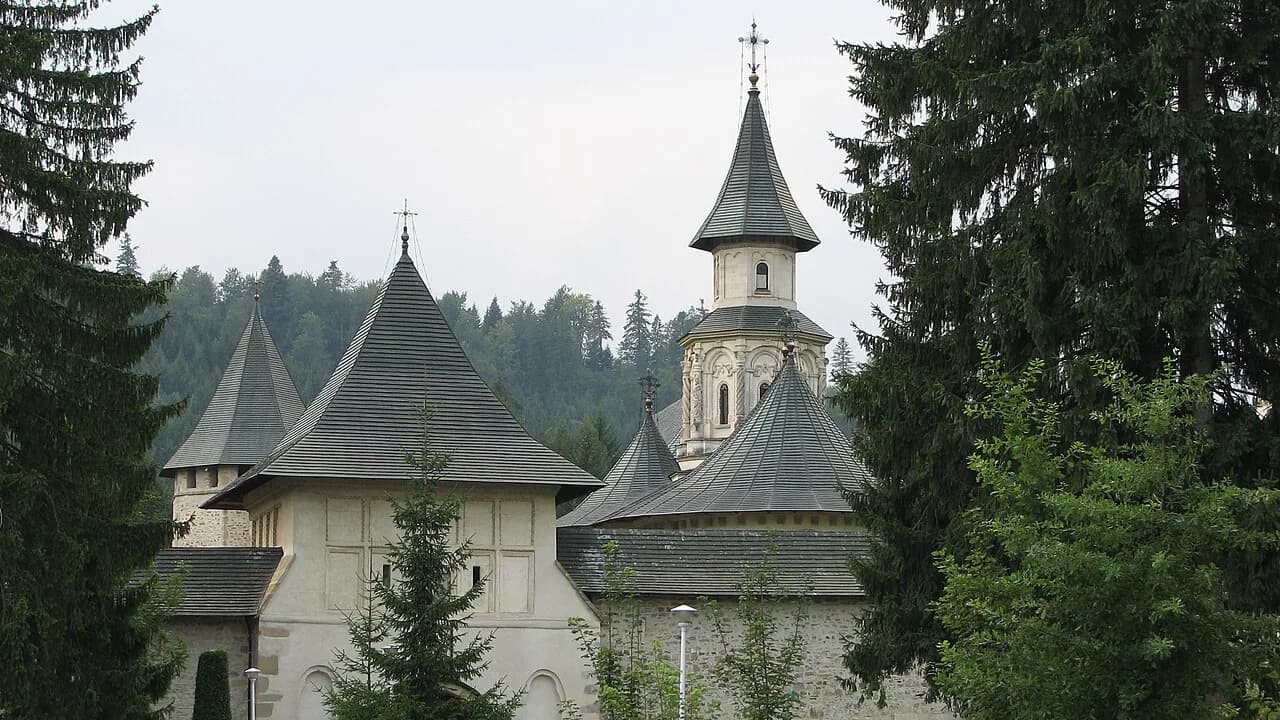
Putna Monastery was built between 1466 and 1481 and is the first and one of the most important foundations of Stephen the Great. The church keeps the miracle-working icon of the Mother of God, brought from Constantinople in 1472 by Maria de Mangop, Stephen's wife. The monastery has survived attacks, occupations, fires and earthquakes across more than five centuries of religious life.
Suceava is the practical base for the whole loop and has enough of its own to fill an afternoon. Saint George's Church, the monastery of St John the New, is a UNESCO World Heritage site, the Bucovina Village Museum is an open-air collection of old wooden houses and traditional objects, and the 14th-century citadel is the town's main tourist site. Suceava was the capital of Moldavia for nearly 200 years, from 1388 to 1565, and was the main residence of the Moldavian princes.
Linking the monasteries by car from Suceava
The monasteries are spread across Suceava County and the surrounding villages, so a car is the efficient way to link them. A guided day run by a local operator covers 250 km round trip from Suceava and takes 9 to 10 hours, which is a fair measure of what the full circuit demands. Build your own loop with the same shape: Suceava out, the monasteries in sequence, and back before dark.
Order the day around the walls rather than the map. Voroneț's west facade wants morning light, Sucevița's north wall is evenly lit at midday, and Humor is small enough to take at any hour. Driving between stops takes longer than the distances suggest because the roads run through villages and forest.
Public transport exists between the towns, but the monasteries sit outside the villages and the connections do not line up with a one-day circuit. Without a car, a guided tour is the realistic option rather than a compromise. If you drive, fill the tank before leaving Suceava and carry cash for the stops along the way.
Taking a guided tour instead: the Royal Tour day
The Royal Tour from explorebucovina runs all year, covers 250 km round trip over 9 to 10 hours, and takes groups of 1 to 8 or private bookings. Its published price range is 55 to 95 euro per person. The itinerary runs Suceava, Putna, the Marginea pottery shop, Sucevița, Moldovița and Voroneț, which is the reverse order of the fresco-light logic above.
Ask the operator before booking whether the order can be flipped so Voroneț comes first, and whether the price is at the low or high end for your group size. Confirm what the rate includes and excludes when you enquire, since that determines whether the headline figure is the real cost. Book through the operator rather than a reseller, so changes go through the people running the day.
A guide pays for itself at Sucevița and Moldovița, where the frescoes need their sequence and political context explained. At Voroneț the wall speaks for itself, so a guide adds least there. If you are choosing between a tour and self-driving, the tour wins on a single day and self-driving wins on two.
How much time to give each monastery
Allow 45 minutes at Voroneț, an hour at Sucevița, 30 to 40 minutes at Moldovița and 30 minutes at Humor, plus 30 minutes at Marginea. That is about three and a half hours of looking inside a 9 to 10 hour day, which is the honest ratio once driving and stops are counted. Cut Humor or Moldovița rather than shortening Voroneț and Sucevița.
At each site, walk the exterior once at a distance before going close, and do the interior afterwards. The painted walls are outside, so the church interior is a separate, quieter visit. This order stops you rushing the facade to get inside.
Light, crowds and steps: the practical constraints
North-facing walls never take direct sun, which is why Sucevița's Ladder of Virtues has held its colour and why it looks flat in a photograph taken at the wrong moment. Voroneț's Last Judgment faces west, so it wants the morning rather than midday. Plan which wall you care about most and put that monastery at the right hour, rather than following the map order.
Tour coaches cluster at the big sites in the middle of the day, so an early start at Voroneț and a late Sucevița avoids the worst of it. The sites involve uneven ground, thresholds and steps into the churches, and the fortified enclosures at Sucevița and Moldovița mean more walking between gate and church. Wear shoes you can walk in on gravel and stone.
Opening hours, ticket prices in lei, closed days and any seasonal closures are set locally and change. Check each monastery's own listing before you travel, and again on the morning of the drive.
Which monasteries to book for
For one day, book Voroneț and Sucevița as the fixed points and add Humor if time allows. For two days, run the full loop with Moldovița, Marginea and Putna, and use Suceava's citadel and village museum to fill the edges. If you are not driving, take the guided day and ask whether the order can be changed so Voroneț comes first.
Decide the transport before you decide the itinerary: a car gives you the light, a tour gives you the context, and one day rarely gives you both. Whichever you choose, the four main monasteries are the spine of the trip and everything else is an add-on.
Explore more Bucovina guides
Sources
Useful notes for your next trip
Optional updates to our guides.
You might also like
Continue reading
More guides you'll find useful