Romanian Easter Eggs: Painted Egg Traditions Explained
Romanian Easter eggs explained: how ouă încondeiate are hollowed and wax-resisted, what the red, Black and gold motifs mean, and how dyed eggs are tapped together.
On this page
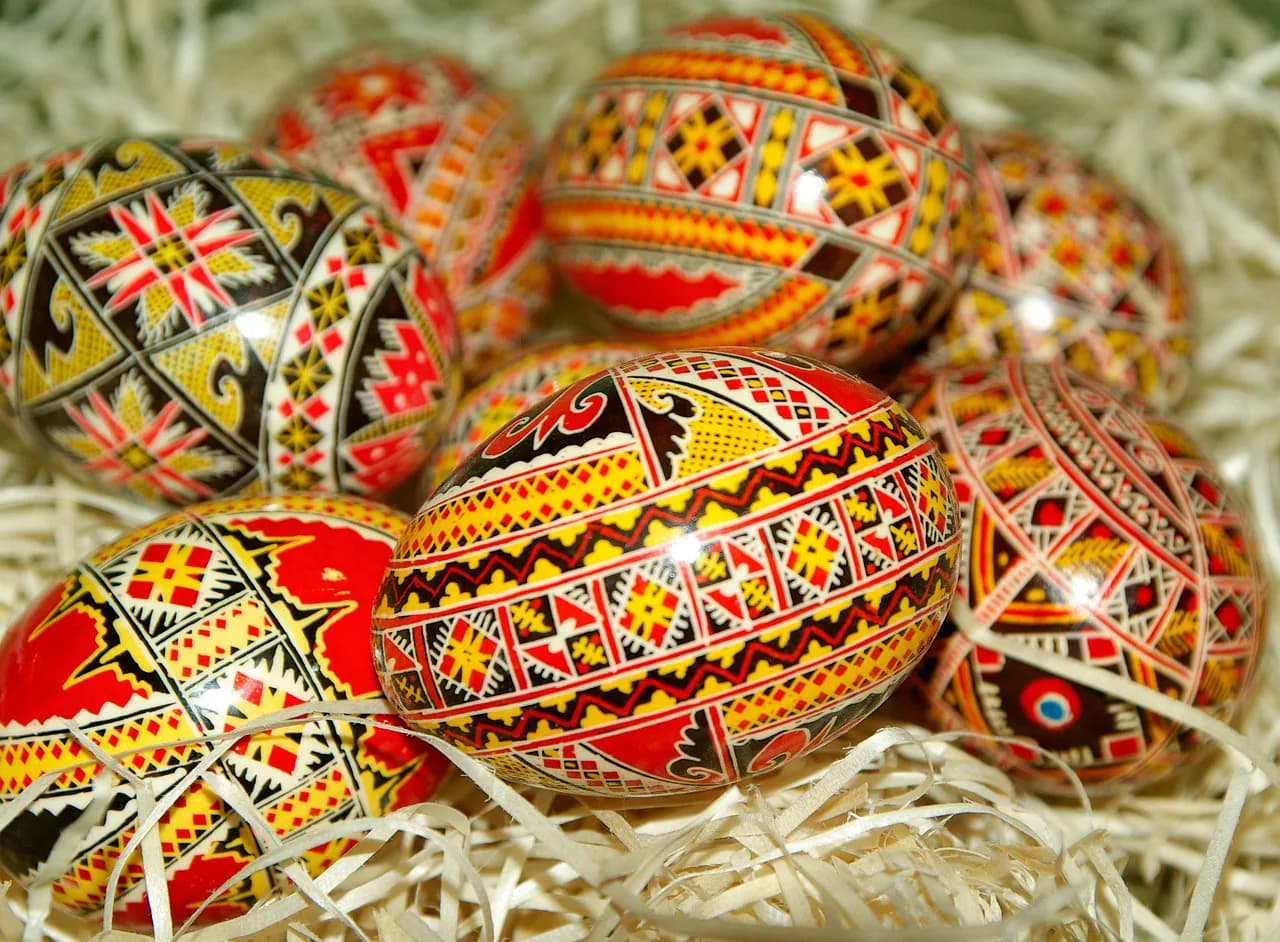
Romanian Easter eggs are two different objects, and keeping them apart is the first step to understanding the craft. Hard-boiled eggs are dyed and eaten, while ouă încondeiate — literally "adorned eggs" — are blown empty and decorated with beeswax and layered dye, then kept as ornaments. This guide covers both, from the kitchen to the wax-resist workbench.
The technique behind the decorated egg is simple to describe and hard to do: lines are drawn in hot beeswax, the shell is dipped in the lightest dye, and the process repeats through progressively darker colours. What remains white is simply what the wax protected. The sections below walk through hollowing, the dye sequence, the onion-skin stencil method, the motifs and colours, and the regional names the craft travels under.
What Romanian Easter eggs are: two objects, one festival
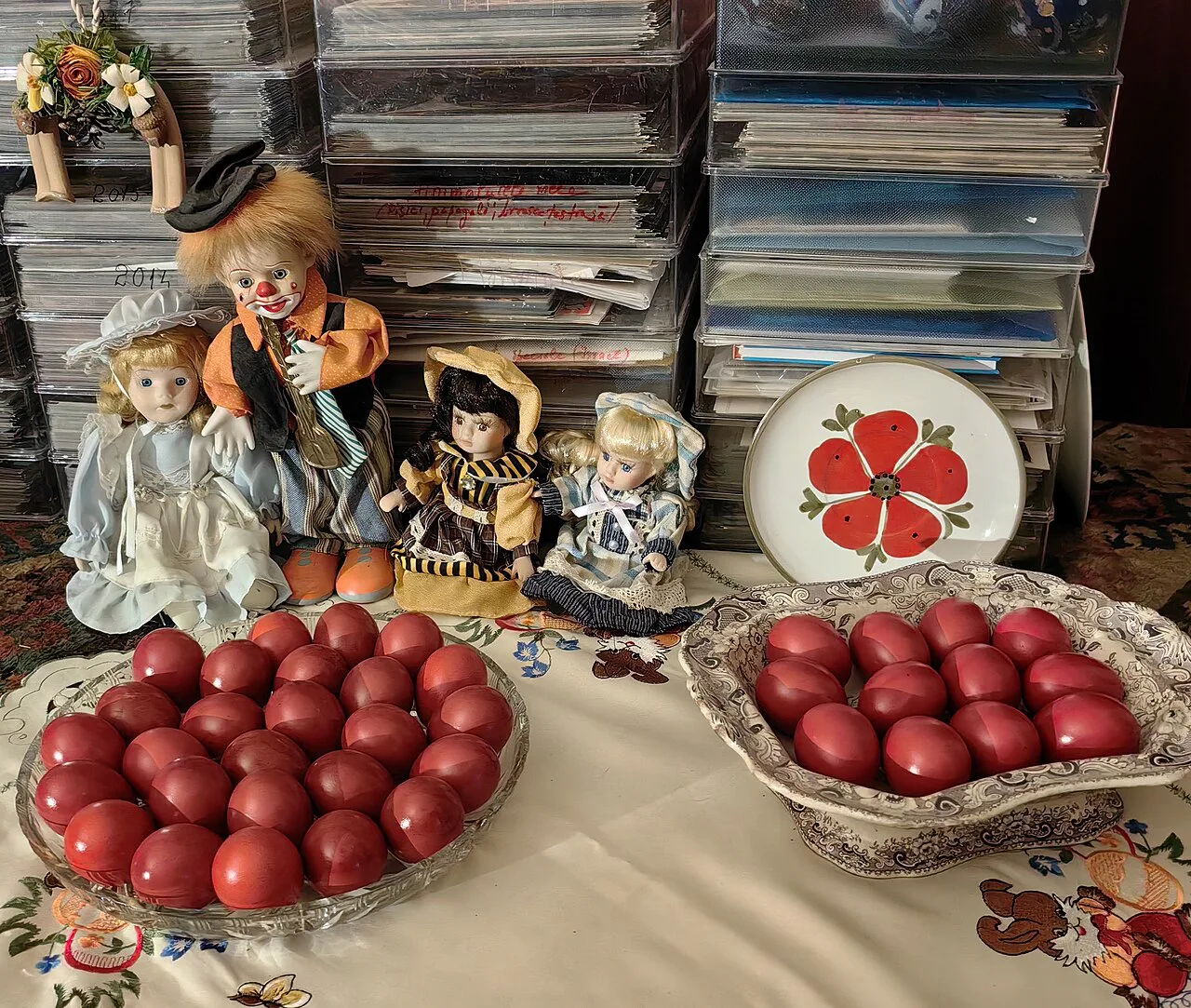
At Romanian Easter tables the dyed egg is food. It is hard-boiled first, then soaked in vinegar and dye so the shell takes colour, and it is meant to be cracked and eaten rather than stored. The decorative ouă încondeiate is a different thing entirely: the raw egg is emptied through pinholes at each end, leaving only a fragile shell that carries elaborate designs and cultural and religious symbolism.
Romanian Easter is a big affair, built around church-going, candles, painted eggs and a great deal of food. Treat the eggs as one part of a longer festival rather than a standalone souvenir, which is why the dyed and the decorated versions sit side by side.
The two objects also have different lifespans, and that shapes how you handle them. A dyed egg is at its best for a few days and belongs on the table; a hollowed decorated shell can last years but will crack under a thumb, so it travels in a box, never loose in a bag. If you want a working overview of where the craft sits among the country's other handmade traditions, our guide to Romanian traditions covers the wider field.
How a decorated egg is hollowed
Hollowing is the step that turns an egg into an object. A fresh raw egg is washed and dried, a thin needle is worked gently into each end until a small hole opens, and the needle goes back in to break the yolk. The maker then blows into one end until the contents come out, leaving an intact shell behind.
The shell is now weak, and every later stage — drawing, dipping, drying — risks a crack. That fragility is why the finished pieces are decorative rather than washable, and why a dropped egg is a lost egg. Practically, a hollow egg should never be filled with water or left where a mug or a laundry basket can catch it.
The wax-resist sequence, step by step
The core method is wax-resist drawing. A thin brush made of wire and a single boar bristle is dipped in hot melted beeswax, and the maker draws the parts of the design that should stay white. Once the wax dries, the egg goes into the lightest dye of the pattern, typically yellow; the wax stops the colour taking, so those first lines read white against it.
From there the egg works from light to dark. The maker next draws the sections that should remain yellow, then dips the egg in a deeper colour such as red, repeating for each successively darker shade in the design. At the end the wax is melted or scraped away and the pattern appears as layers of dye.
Understanding that order explains most of what you see on a finished egg. Yellow flowers on a Black ground are not painted on afterwards; the flower was protected before the Black went on. Once you know the sequence, you can read approximately how many dips an egg took by counting its colours.
The technique rewards a steady hand and a warm wax pot, and there is no shortcut: each colour needs its own drying time before the next wax lines go down. That slowness is worth remembering when you are deciding what a decorated egg represents. A directly painted design on wood or a statue takes a different route, and pieces like the Fabergé eggs were finished with gold and precious gems rather than wax resist.
The plant-stencil method
Not every decorated egg is wax-resisted. A separate approach ties a small leaf or flower against the shell, or wraps it with the egg in a transparent cloth, and boils it with onion skins. The skins dye the egg a dark red-brown, and peeling the leaf away leaves its imprint behind in the lighter shell.
This is the version to try at home if you want a result on the first attempt, because the leaf does the drawing for you. Onion skins are the dye bath, a leaf is the resist, and the pattern is whatever silhouette you tied on.
What the colours mean
Red is the anchor of Orthodox Easter egg colouring, dyed for the blood of Christ whether the egg is destined for eating or for keeping. Decorated eggs usually move between Black, red and gold, with blue and green sometimes used as well, summoning death and rebirth at once.
Red carries the festival's meaning, and decorated eggs usually move between Black, red and gold, with blue and green sometimes used as well, summoning death and rebirth at once. If you are buying, the colour count is a rough proxy for the number of dye dips involved. An egg in three or four colours took more passes of wax than a single-colour shell.
Motifs: geometry, flowers and crosses
Designs are mainly geometric, running from simple bands to dense, intricate fields, with stylised flowers and other plant life also common as a celebration of the life that returns in spring. Religious symbols, crosses among them, can appear too, so an Easter egg can be both religious artwork and decorative folkcraft.
For a buyer, motif is the clearest guide to the hand behind the egg. Tight, evenly spaced geometric lines suggest a practised maker working with a single-bristle brush, while loose freehand plant shapes suggest a quicker piece. That is the sort of distinction worth applying when you compare pieces within Romanian folk art traditions.
Tapping dyed eggs together
The hard-boiled, dyed egg has its own ritual. The British Museum records that in Romania the coloured eggs are tapped together, which turns the first egg of Easter into a small contest as much as a food.
This is why the dyed egg is boiled rather than blown: it has to be edible after the game. Keep the two categories separate in your head and nothing about Romanian Easter eggs is confusing — one is played with and eaten, the other is drawn and kept.
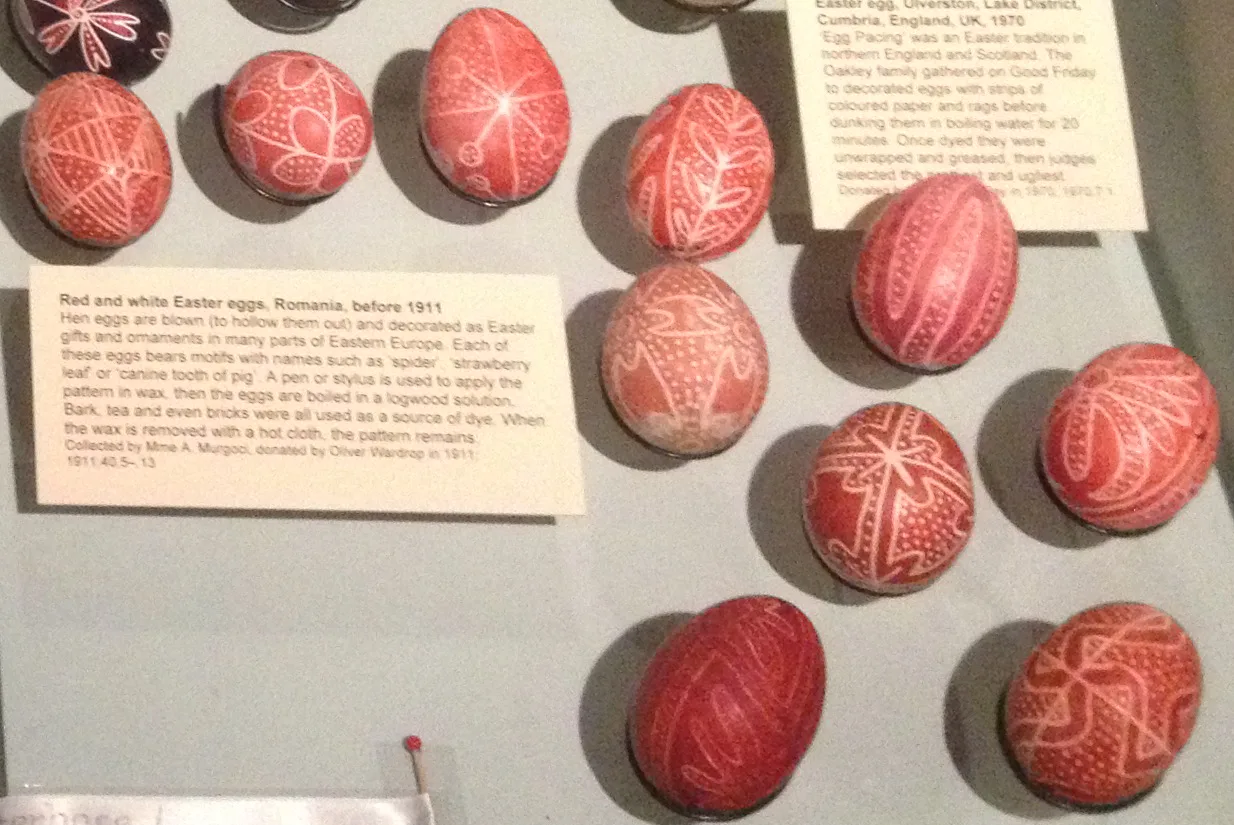
Romanian decorated eggs in the wider region
Elaborately decorated Easter eggs run right across Central and Eastern Europe, and Romania's ouă încondeiate are one version of a shared craft. The names shift by country — pysanky in Ukrainian, pisanica in Croatian, pisanka in Polish — but the wax-resist idea is recognisably the same family of work.
Those Slavic names are usually traced to an Old Slavonic word for "to write", because Christian iconographic tradition often describes the making of religious art as writing rather than painting. Treat that as one explanation of the name rather than settled etymology, but it is a useful way to think about the craft: the wax line is a sentence, and the dye fills in around it.
The same decorative instinct appears on other Romanian surfaces, notably icons on glass, where paint and line carry religious narrative much as wax and dye do on a shell. If the symbolism is what draws you rather than the egg itself, that tradition is the deeper dive.
What to look for when you buy a painted egg
Start with the shell itself. A hollowed eggshell with visible wax-resist work — layered colour, white lines that could only have been protected rather than applied — is the real craft. A solid, heavy egg with designs sitting on top of the surface is decorated, but by a different method.
An alternative method, usually used on wooden eggs or statues rather than eggshells, is to paint the designs directly, and such pieces can be further decorated with beads. That is not usually called pysanky, a term defined by the wax-resist technique, so a wooden egg described as pysanky deserves a question.
Practical buying checks: turn the egg and look for pinholes at both ends, run a fingertip lightly over the lines to feel whether colour sits under a wax edge or thickly on top, and ask whether the piece is shell or wood. For the wider picture of what is worth carrying home and how to spot good work, see Romanian souvenirs.
Pack a hollow shell the way you would pack a light bulb. A small rigid box with soft padding is enough, and a hollow egg should travel in hand luggage rather than a checked bag. A wooden egg will survive more, but it is also the piece most likely to be factory-painted rather than hand-drawn.
Which egg are you actually buying?
Decide first whether you want a dyed egg for the table or a decorated shell for a shelf, because they are made by different processes and break in different ways. If it is the decorated kind, look for pinholes, layered colour and wax-protected white lines, and ask directly whether the piece is shell or wood.
For the festival as a whole rather than the craft alone, our guide to Romanian traditions puts Easter alongside the country's other seasonal customs, and the Romanian folk costume piece covers the dress that goes with the church-going. Between them you get the occasion and the object, which is the pair that makes sense of an Easter egg.
Explore more Romania guides
Sources
Useful notes for your next trip
Optional updates to our guides.
You might also like


Continue reading
More guides you'll find useful