Romanian Souvenirs Worth Buying and Where to Find Them
A practical guide to Romanian souvenirs, from embroidered shirts and ceramics to books and prints, with named Bucharest shops and online makers to buy from.
On this page
The Romanian souvenirs worth carrying home are crafts and printed goods: hand-embroidered shirts, pottery, carved wood, textiles, books and illustrated prints. Small dedicated stores selling traditional gifts and authentic products crafted in wood, fabric or ceramic sit mostly in Bucharest's historical centre, on a rough route from Calea Victoriei to French Street. This guide covers what to buy, where to find it in Bucharest and which Romanian makers sell online.
It is a commercial guide, not a cultural history: each section names a shop, a maker or a category and explains the trade-off, whether that is price against handwork or a bulky item against luggage space. For the wider context behind the objects, the site's Romanian traditions section covers costume, eggs, folk art and painted churches.
What counts as a Romanian souvenir
Think in materials rather than slogans. The souvenirs that age well are the ones a named workshop or maker actually produced: embroidered cloth, glazed pottery, carved wood, woven wool, painted glass and printed paper. Bucharest museums illustrate the life and traditions of the countryside, which makes the Village Museum and the Romanian Ethnographic Museum a sensible first stop if you want to recognise good craftwork before you buy.
Skip anything that could have been made anywhere. One visitor review of Romanian gift shops singles out authentic Romanian souvenirs as the exception next to shops selling Chinese-made goods, and that is the distinction worth carrying in your head.
The costume tradition behind the shirts and textiles has its own vocabulary, from the cut of a blouse to the meaning of a pattern, and the site's Romanian folk costume page explains it before you spend money. Knowing what a handmade piece involves also helps you judge whether a cheaper version is machine-embroidered.

Embroidered shirts and traditional clothing
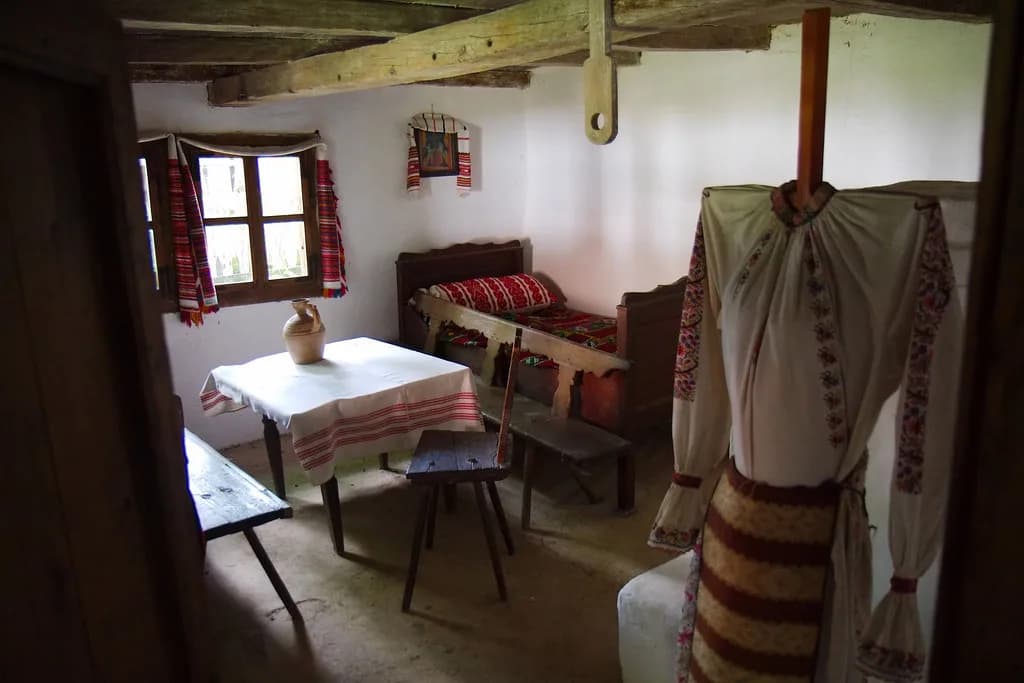
A handmade ie, the Romanian embroidered blouse, is handwork you can feel: the stitching is dense, the pattern repeats cleanly and the linen or cotton has weight. Romanian Ie sells a wide range of handmade embroidered shirts and other clothing if you want the old-school version.
The other option is reinterpreted ie: traditional designs blended with minimal modern cuts. Iiana takes that approach, with a men's shirt range worth looking at if you want something wearable beyond a festival. Neither route is more authentic; one is a craft purchase, the other a design purchase, and the price difference should reflect that.
For pattern-led clothing more broadly, Fuyor embroiders traditional patterns onto T-shirts, hoodies and shoes, and Plai cu grai applies traditional motifs to T-shirts, jackets, bookmarks and brooches. Try these on before flying if you can, because sizing bought blind is the usual regret.
Ceramics, wood and textile crafts from small workshops
Pottery is the most packable craft souvenir: heavy enough to feel real, small enough for hand luggage if you wrap it in clothes. The most reliable hunting ground in Bucharest is the run of small stores in the historical centre selling products crafted in wood, fabric or ceramic, so plan a slow walk rather than a single stop.
Small workshops cover the rest of the craft field. Țara lui Papion, a small workshop in Sibiu, makes designed bowties and accessories for women; Cosanzeana makes small crafted objects, brooches, decoration and funky T-shirts; and Plai cu grai works embroidery into textiles. Wooden and embroidered pieces travel better than anything glazed or framed.
If pattern and ornament are your interest rather than a single object, the site's Romanian folk art page covers the visual language that runs through carved wood, textiles and painted interiors, and the region's UNESCO sites cover the churches and villages where much of it comes from.
Books, prints, postcards and illustrated gifts
Printed goods are the easiest souvenirs to justify: flat, light and genuinely Romanian. Bucharest bookshops carry photo albums of the city and the country alongside Romanian books, and they make a better record of the trip than another fridge magnet.
Illustrated work from individual makers is the strongest option in this category. Madalina Andronic sells hoodies, puzzles, prints, postcards and books in an artistic design, and Diana Tivu, a book illustrator, makes mugs, prints and tote bags drawing on Romanian traditions.
Icons are a separate category with their own etiquette: painted on glass in Transylvania, they are religious objects first and souvenirs second. The site's icons on glass page explains the technique and the museums that hold the best examples, which is the right place to start before you buy one.
Where to shop in Bucharest
Start on Magheru Avenue at Cărturești, whose bookstore offers a refined selection of gifts: a Romanian book, a jar of traditional homemade jam or a local wine, plus photo albums capturing Bucharest or the whole country. If you want photographs of Romania, Humanitas Kretzulescu is the other bookshop to visit.
Then take the craft route through the historical centre, from Calea Victoriei Avenue along French Street and finishing at Unirea Shopping Center. Bucharest galleries are an alternative if you want a unique piece, and wine bars or dedicated stores cover the drinkable option, though food and drink souvenirs are outside this guide's scope.
Set expectations about opening hours before you go, since these change with the season and the shop: confirm times with the individual shop on the day, and treat museum opening hours as the fixed part of any craft-focused day. Bucharest's museums stay the best place to see the country's crafts, and they are worth an hour even if you buy nothing.
Shopping online from Romanian makers
If you want to buy before you fly or after you return, Romanian makers sell direct through their own websites. Madalina Andronic, Fuyor, Diana Tivu, Plai cu grai, Cosanzeana and Țara lui Papion all run their own shops, and Email de Sighișoara sells enamelled metal kitchenware made in Sighișoara.
Two broader shops cover the rest. Fabricat in RO is an online stop for Romanian-made products across jewellery, toys, clothing and more, and Bucovina Shop concentrates on Bucovina, the region the painted churches belong to. Check stock, sizing and delivery terms with each shop directly, since these vary from maker to maker.
How to tell an authentic Romanian souvenir from imported goods
Look for a named maker, a workshop address or a pattern that belongs to a specific region. The stores that describe themselves as selling traditional gifts and authentic products crafted in wood, fabric or ceramic are making a claim you can test by asking where the piece was made. If the answer is vague, the object probably came from a wholesale catalogue.
Judge handwork by inconsistency: slight variations in embroidery, brushwork or glaze are the mark of a person, while perfect repetition points to a machine. The review quoting the difference between authentic Romanian souvenirs and shops selling Chinese-made goods makes the same point from a shopper's perspective, and it is one opinion, not a ranking.
What packs well and what to leave for the return leg
Textiles, printed goods, jewellery and small carved pieces pack flat or soft and are the safest buys on a low-cost flight. Ceramics need wrapping and belong in hand luggage, while framed prints and anything glazed and large are better shipped. Embroidered eggs are the fragile extreme: the site's Romanian Easter eggs page covers Ouă încondeiate and the onion skins and wax technique behind them, and they need a rigid box, not a rucksack.
Leave bulky furniture, large textiles and anything you cannot carry up a Bucharest stairwell for an online order to your home address. That way the trip stays light and the makers still get the sale.
Build a short shopping list before you fly
Pick two or three categories, not everything: an embroidered shirt or blouse, a piece of pottery, and a book or print cover most travellers. Buy the shirt from a maker you can size properly, buy pottery in person so you can check the glaze, and order the rest online when you get home.
In Bucharest, give the historical centre one unhurried afternoon: Cărturești on Magheru Avenue, Humanitas Kretzulescu, then the walk from Calea Victoriei to French Street and Unirea Shopping Center. Confirm current opening hours with each shop before you set out.
Explore more Romania guides
Sources
Useful notes for your next trip
Optional updates to our guides.
You might also like


Continue reading
More guides you'll find useful